Foundations of Clinical Research · Level 1
From Clinical Question to Publication
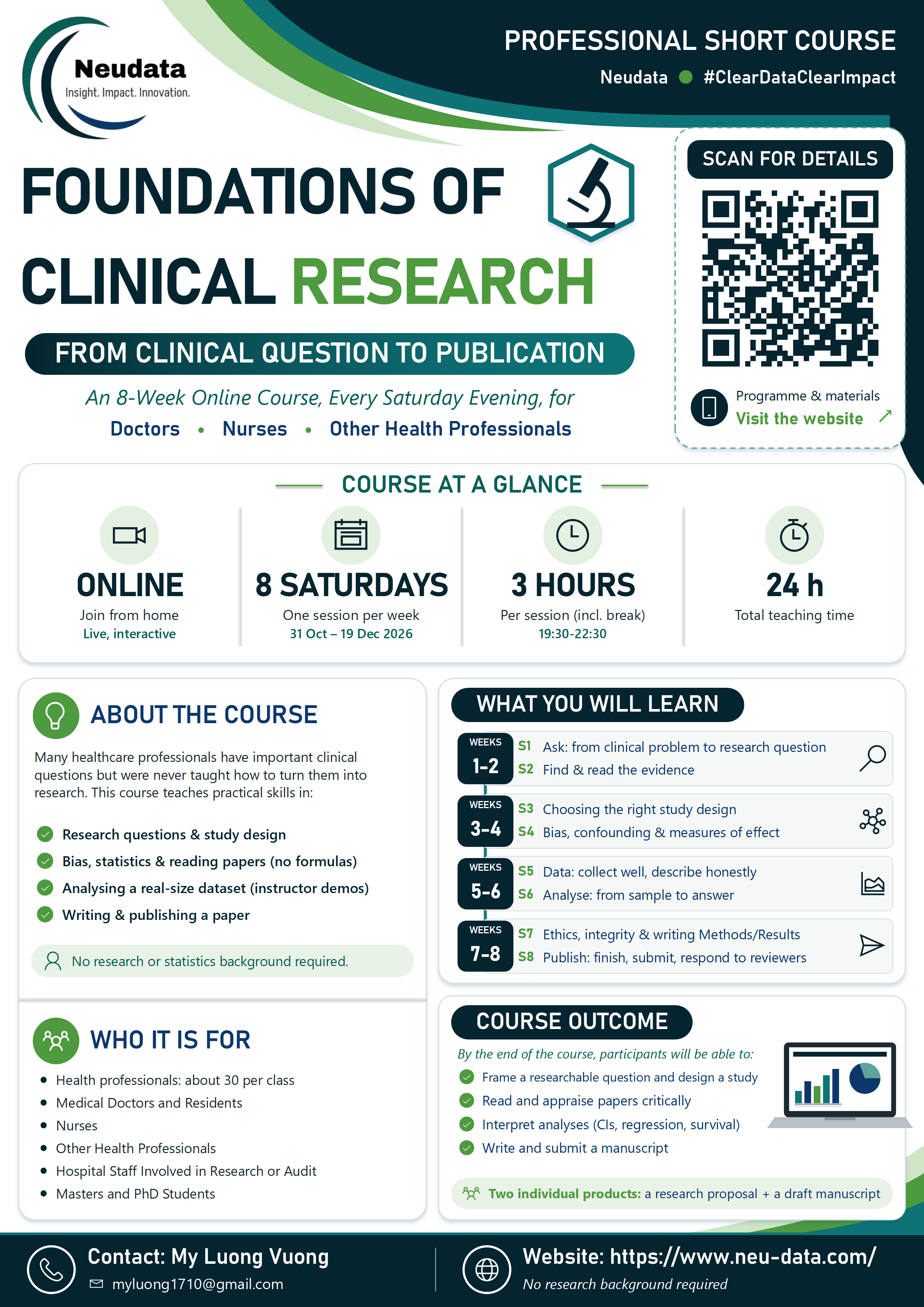
Level 1 Online 8 Saturdays, 19:30–22:30 one session per week 24 contact hours No software needed EN + VN
About this course
Clinical staff make decisions every day that research could improve, but few have been taught how to turn a bedside uncertainty into a published study. Over eight weeks, with one 3-hour online session every Saturday evening (19:30–22:30), this course walks the whole road of research: asking a good question, finding and reading the evidence, choosing a design, recognising bias, collecting and analysing data, protecting participants, writing the paper and getting it published.
- Slow and visual. Built for participants with no research background: pictures first, a “check your understanding” every 20 minutes, no formulas beyond a 2×2 table, and extra slides at the end of each session for anyone who wants to read further at home.
- Online, one class. You join from home. There are no groups or breakout rooms: every exercise is done by the whole class together, with polls and the chat.
- The whole road in one course. Weeks 1–4 build understanding and design skills; Weeks 5–8 read the results of a realistic simulated dataset (FLUID-ICU, 620 ICU patients) through live instructor demos in R, and each participant writes them up as a manuscript.
- Level 1 of three. This course is Level 1. Level 2 is a separate hands-on course in R for those who want to run analyses themselves (in preparation). Level 3 covers advanced, specialised methods on request. See Course levels.
- One running example: fluids in septic shock. The example is followed through question and search, design, analysis, write-up and publication, and appraised through two real papers.
Eight Saturdays, eight sessions
Two individual products
1 · A research proposal
On your own clinical question from your department, with a publication plan. Each part is shown live on the running example and you write your own as homework. Everyone submits it in Session 8; about 5 volunteers also present it (6 minutes + 2 minutes feedback).
2 · A draft manuscript
From the course dataset FLUID-ICU: you choose one of the five questions (Q1 to Q5). We give you the results in a results pack, and you write the paper: Methods and Results after Session 7, the rest after Session 8. After the course, you peer review one classmate's draft and reply to the review of yours like a real author.
Who it is for
Health professionals (doctors, nurses, etc.), about 30 participants per class, joining online from home. No research or statistics background is assumed, and no software is needed: the trainers run the analyses and you learn to read, interpret and write them up. You need a computer with a stable internet connection, camera and microphone.
How to start
- Request your free access code (once per browser).
- Read the participant handbook and look at the schedule.
- Each session page has the agenda, the slides, the exercise sheet and what to prepare.
Trainers
Vương Mỹ Lượng
Senior Biostatistician, Neudata
Bernard Osang'ir
Senior Biostatistician, Neudata
Contact
Questions about the course: contact Vương Mỹ Lượng at myluong1710@gmail.com.
Neudata Consulting Ltd · www.neu-data.com