Session 8 · Publish: finish the paper, get it out, present
Foundations of Clinical Research: From Clinical Question to Publication
Vương Mỹ Lượng & Bernard Osang’ir
Neudata Consulting Ltd

Session 8 · Publish: finish the paper, get it out, present
Part 1
Week 8 · Saturday, 19:30-22:30 (online)
- 19:30 Recap: Session 7
- 19:35 8.1 Writing the paper (II): Introduction, Discussion, Abstract, Title
- 20:00 Manuscript workshop 2: Q1 together, then your own
- 20:30 8.2 Getting published: from checklist to reviewers
- 21:05 8.3 Be the reviewer: Papers 1 and 2, as a whole class
- 21:30 Proposal presentations (about 5 volunteers), 22:15 closing
Recap: three questions from Session 7
QUICK QUIZ · 5 min
- Who consents for a sedated patient in septic shock?
- Which STROBE item asks for crude and adjusted estimates?
- Where does ‘this may be because sicker patients got more fluid’ belong?
Answers
- The legal representative (or deferred consent, if the committee approved it)
- Item 16 (main results)
- Discussion, not Results
OUTPUT Everyone back in writing mode
8.1 | 25 minutes
Writing the paper (II)
Introduction, Discussion, Abstract and Title, in that order
Introduction: a funnel in three paragraphs
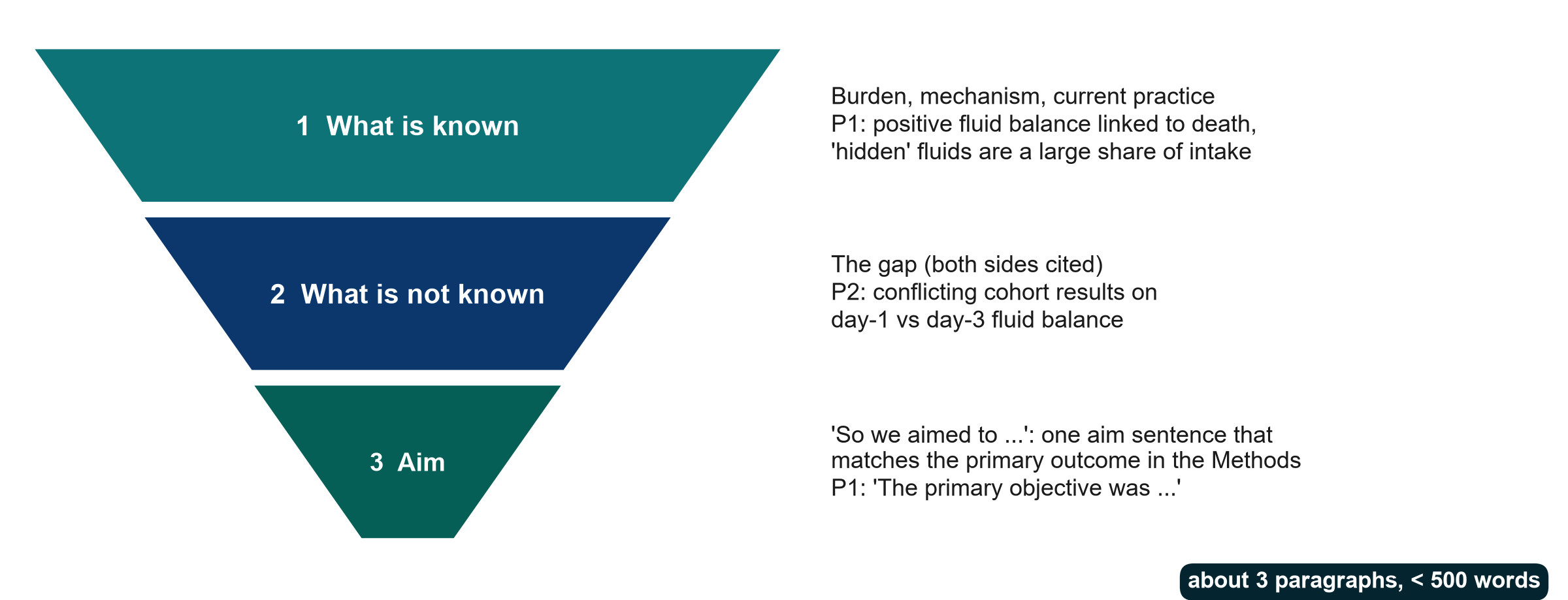
KEY MESSAGE Known, unknown, aim. The aim matches the primary outcome.
Worked example: the Introduction funnel for FLUID-ICU (Q1)
1 Known
- Fluids save lives early in sepsis
- A positive balance is linked to death (Paper 2 and other cohorts)
2 Not known
- Sicker patients get more fluid
- Unclear whether the link remains after adjusting for severity
3 Aim
- We examined whether a positive balance by day 3 is associated with 28-day mortality, after adjustment
KEY MESSAGE Three paragraphs, about 350 words. The aim uses ‘associated’.
Discussion: six moves
1 Answer
- First sentence answers the question
- Paper 1, p.8
2 Compare
- With other studies, and why they differ
- Paper 1: vs CLASSIC, POINCARE-2
3 Explain
- Mechanism, briefly
- Paper 2: four-phase fluid model
4 Limits
- Specific: mechanism, direction, fix
- Paper 1: control-group contamination
5 Implications
- For practice and research, labelled
- Paper 1: ‘would probably be advantageous’ is speculation
6 Conclusion
- Same message as abstract and title
KEY MESSAGE Answer first. Limitations with their direction. Conclusion = abstract = title.
Worked example: the Discussion for FLUID-ICU question 1
Six moves, one sentence each (simulated data).
- 1 Answer: A positive balance by day 3 was associated with higher 28-day mortality (adjusted OR 1.62, 95% CI 1.02 to 2.59).
- 2 Compare: This agrees with Paper 2 (day-2 HR 2.13), although our adjusted estimate is smaller.
- 3 Explain: Most of the crude association (OR 2.49) reflected confounding by indication: sicker patients received more fluid.
- 4 Limitations: Residual confounding and reverse causation may exaggerate the association. The CI of the adjusted Cox HR reached 1.00.
- 5 Implications: These data do not justify restricting fluid. A randomised trial (like Paper 1) is needed.
- 6 Conclusion: ‘associated with’, the same verb as the aim, abstract and title.
Why the odds ratio shrank: explain it in the Discussion
FLUID-ICU Q1 (simulated)
- Crude OR 2.49 (1.70 to 3.70)
- Adjusted OR 1.62 (1.02 to 2.59)
- Imputed OR 1.70 (1.09 to 2.64)
- Gap = confounding by indication
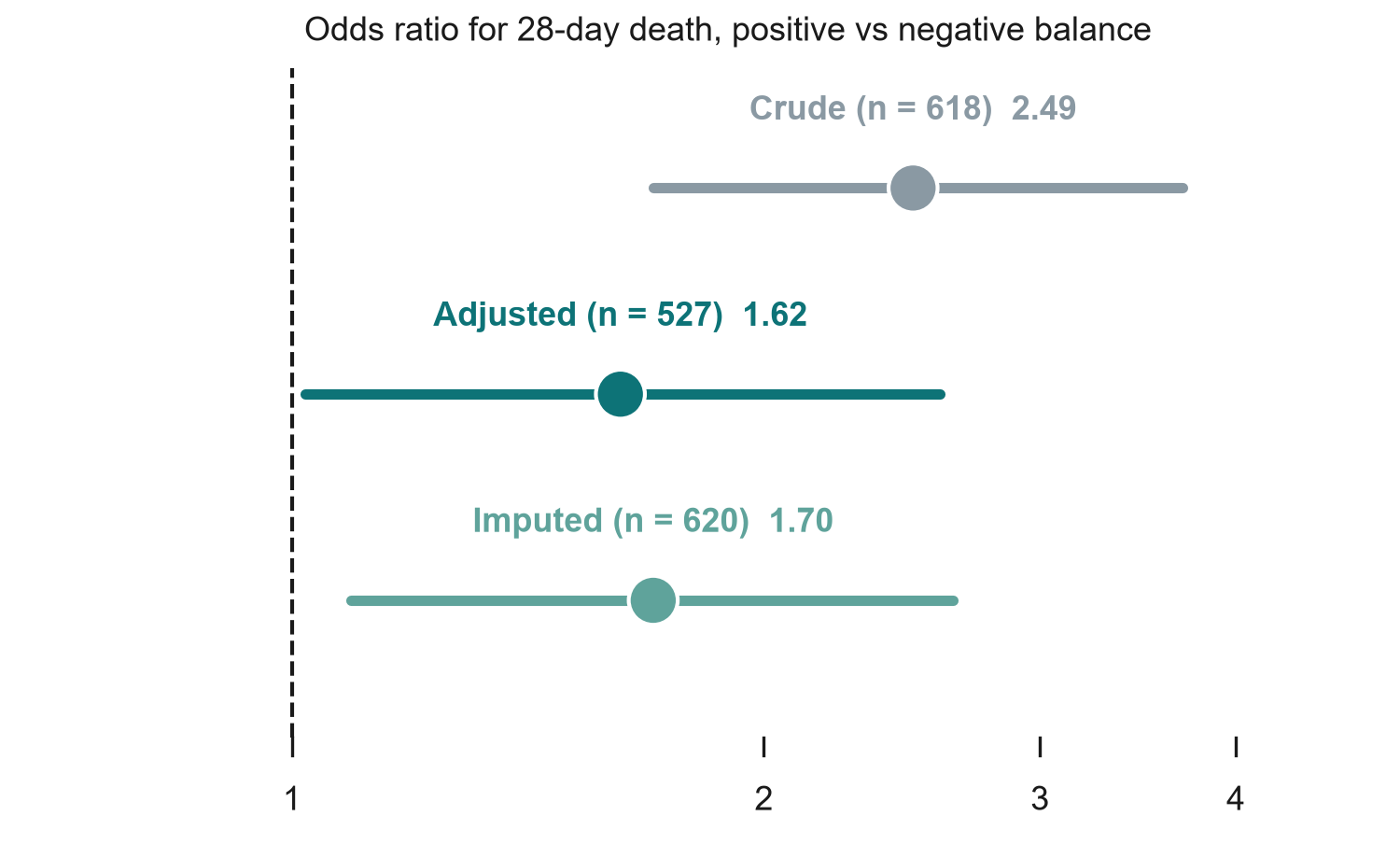
KEY MESSAGE Report both, explain the gap. Keep the verb at ‘associated’.
Calibrated language: match the verb to the design
Stronger claim = needs a stronger design
| Verb (strongest at the top) | Needs at least |
|---|---|
| ‘causes’, ‘prevents’, ‘proves’ | Several large RCTs agree |
| ‘reduced’, ‘increased’, ‘did not reduce’ | A randomised trial (Paper 1) |
| ‘may contribute to’, ‘is consistent with’ | Observational + causal reasoning |
| ‘is associated with’, ‘predicts’ | Cohort, case-control (Paper 2) |
| ‘was observed in’, ‘was common’ | Descriptive, case series |
Never: ‘trend’ for p = 0.42. ‘No difference’ (say ‘no evidence of a difference’). ‘First’, ‘ever’, ‘novel’ unchecked. ‘Impact’ in an observational study.
KEY MESSAGE Climb the ladder only as far as your design allows.
Check: fix the verb (FLUID-ICU, simulated)
QUICK QUIZ · 2 min
- ‘A positive balance caused higher mortality (OR 1.62).’
- ‘Fluid overload increases AKI (acute kidney injury) (OR 1.27 per 10 ml/kg).’
- ‘There was a trend towards death (Cox HR 1.46, 95% CI 1.00 to 2.13).’
- ‘Lactate predicts death (OR 1.39 per mmol/L).’
Better
- ‘… was associated with …’
- ‘… was associated with higher odds of AKI’
- ‘HR 1.46 (1.00 to 2.13): the CI reaches 1’
- Fine for prediction. For cause, ‘associated with’
The structured abstract: the shop window
| Section | What it must say | Good example |
|---|---|---|
| Background | Problem, gap and aim in 1-2 sentences | |
| Methods | Design, setting, participants, exposure, primary outcome, analysis | Paper 2: population, setting and size |
| Results | Numbers analysed. Main effect with 95% CI. Key secondary results | Paper 2: every result as HR (95% CI) |
| Conclusion | Answer the aim in words the design allows | Paper 1: negative result stated plainly |
250-300 words, plus the registration number for trials. Fix in Paper 1: medians reported, but the estimate called a ‘mean difference’.
Worked example: the abstract and title for FLUID-ICU question 1
Copy the numbers from your Results (simulated data, about 120 words shown).
- Title: Positive fluid balance by day 3 and 28-day mortality in sepsis: a multicentre cohort study
- Background: A positive fluid balance is linked to death in sepsis, but sicker patients receive more fluid. We examined the association after adjustment for severity.
- Methods: Prospective cohort (simulated teaching data), 620 adults, 4 ICUs, 2023-2024. Exposure: positive balance by day 3. Outcome: 28-day death. Logistic and Cox regression adjusted for severity.
- Results: Of 618 patients, 373 (60.4%) had a positive balance, 35.9% vs 18.4% died. Crude OR 2.49 (1.70 to 3.70), adjusted OR 1.62 (95% CI 1.02 to 2.59).
- Conclusions: A positive balance was modestly associated with 28-day mortality. Most of the crude association reflected severity. A randomised trial is needed.
Title and keywords: your PICO in one line
Formula from your PICO: design, I vs C, in P, on O. 10-16 words. No ‘impact’, ‘novel’, ‘first’.
Paper 1 (trial)
- Published: ‘Impact on fluid balance of an optimized restrictive strategy targeting non-resuscitative fluids in … septic shock: a single-blind, … pilot study’
- Problem: over 25 words, value words
- Better: Restricting non-resuscitative fluids in septic shock: a multicentre pilot randomised trial
Paper 2 (cohort)
- Published: ‘Impact of a cumulative positive fluid balance during the first three ICU days in patients with sepsis: a propensity score-matched cohort study’
- Problem: ‘impact’ is a causal word for a cohort
- Better: Positive fluid balance in the first three ICU days and 28-day mortality in sepsis: a propensity-matched cohort
KEY MESSAGE Keywords: 3-6 MeSH terms (PubMed subject headings) not already in the title.
Before you submit: references, checklist, final read
References
- Use a reference manager
- Check every citation
- Paper 2 cites the wrong reference for its covariates
Reporting checklist
- Fill it in while writing
- Add page numbers
- Neither paper names CONSORT or STROBE
Final read
- Text = table, for every number
- Call-outs point to the right figure
- A colleague reads the tables
KEY MESSAGE Most errors in these two papers needed no new data, only a careful co-author.
Manuscript workshop 2 | 30 minutes
Complete the draft: together, then on your own
22 minutes drafting Q1 live with the whole class, then 8 minutes on your own aim and title
Manuscript workshop 2, part 1: we complete Q1 together
WHOLE-CLASS TASK · 22 min
- Introduction (6 min): three paragraphs. You suggest sentences aloud when called on
- Discussion (9 min): six moves, one or two sentences each
- Abstract (5 min): numbers copied from the class Results
- Title and verb check (2 min): every ‘cause’ or ‘impact’ becomes ‘associated with’
Use
- Class Q1 draft from Session 7 (PDF)
- Results pack Q1
- The worked examples (slides)
OUTPUT A complete class draft for Q1, shared as a PDF after the session
Manuscript workshop 2, part 2: your own aim and title
INDIVIDUAL TASK · 8 min
- Write the aim sentence for your question (Q1 to Q5)
- Write your title: design stated, 10-16 words, ‘associated’
- Two volunteers read their title aloud. The instructor comments
- Tonight: add the Introduction, Discussion and Abstract. Submit by 23:59
Submit
- Complete draft, about 2,000 words
- By 23:59 tonight
- Course folder or email to the course lead
- Then the peer review (closing slides)
OUTPUT Your aim sentence and working title. The complete draft submitted by 23:59 tonight
8.2 | 20 minutes
Getting published
From checklist to reviewers, and the traps on the way
Reporting guidelines: choose by design
| Study design | Reporting guideline | Our example |
|---|---|---|
| Randomised trial | CONSORT | Paper 1 |
| Cohort, case-control, cross-sectional | STROBE | Paper 2, FLUID-ICU |
| Diagnostic accuracy study | STARD | |
| Systematic review or meta-analysis | PRISMA | |
| Trial protocol | SPIRIT | |
| Case report | CARE |
All checklists are free at the EQUATOR Network (equator-network.org). Name your guideline in Proposal Part 4 and use it as a writing checklist.
Choosing a journal: four checks
Decide the target journal before you write: it sets the rules.
Fit
- Who needs your result?
- Read 3 recent issues
- Similar designs published?
Trust
- Indexed in MEDLINE, DOAJ, Scopus or Web of Science
- Clear peer-review policy
Rules
- Guide for Authors
- Word limit, checklist
- Registration required?
Cost and speed
- Article fee (APC) and waivers
- Licence: who may re-use the paper
- Paper 1: 7 weeks. Paper 2: 7 months
KEY MESSAGE A good journal is one your readers read, and one that is honestly run.
Spot the predatory journal
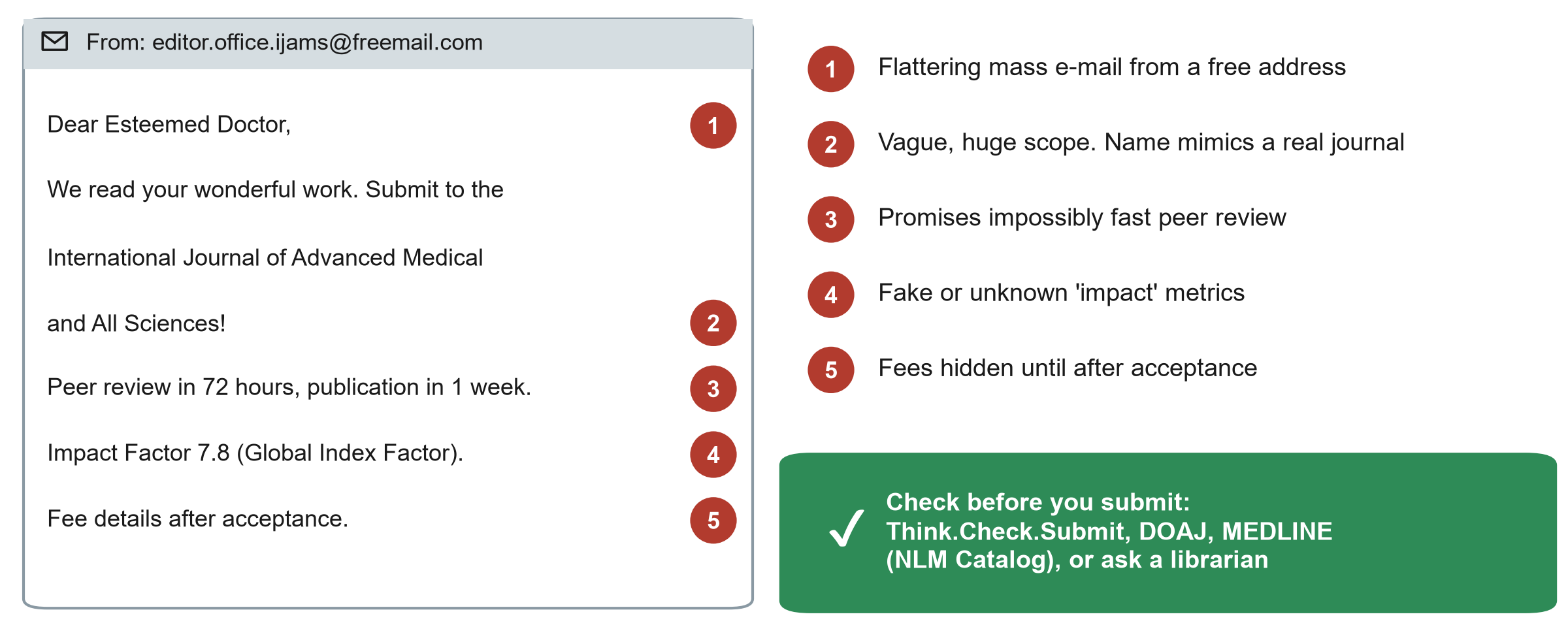
KEY MESSAGE If a journal finds you by flattering e-mail, check it twice.
Live demo: find a checklist and check a journal
LIVE DEMO · 3 min
- Open the EQUATOR Network website and search ‘CONSORT’
- Show the checklist and the flow diagram (Paper 1 has one)
- Find STROBE the same way (Paper 2 and FLUID-ICU)
- Check a journal in DOAJ and in the NLM Catalog
- Open the Think.Check.Submit checklist
Watch for
- Where the checklist PDF is
- How to see if a journal is in MEDLINE
- Three questions to ask any journal
OUTPUT Everyone checks the journal and guideline in their own publication plan at home
The submission package
| Item | What it contains |
|---|---|
| Cover letter | Why this journal, what is new. Not under review elsewhere |
| Title page | Authors, affiliations, ORCID iDs (free researcher identifiers), corresponding author, word count |
| Manuscript | IMRaD, formatted as the Guide for Authors says (blinded if asked) |
| Tables and figures | Separate files, right format and resolution |
| Reporting checklist | CONSORT, STROBE …, with page numbers |
| Declarations | Ethics number, consent, conflicts of interest, funding, data sharing, author roles, AI use |
| Registration number | Trials and systematic reviews |
| Suggested reviewers | Experts with no conflict, not recent co-authors |
| Supplementary files | Protocol, extra tables, long flow charts |
The peer-review journey
Rejected? Improve the paper, then submit to another journal. Never to two at once.
Submit
- Manuscript, cover letter, checklist
Editor
- Screens the paper
- Desk rejection is common
Reviewers
- 2 or 3 peer reviewers comment
Decision
- Accept, minor or major revision, or reject
Revise
- Change the paper
- Reply point by point
Accepted
- Proofs, then publication
KEY MESSAGE Most papers are revised before acceptance. Reply to every point politely.
Responding to reviewers: the point-by-point table
Comment, response, and exactly where the paper changed. Illustrative rows built on the annotated Paper 1.
R1.1
- Comment: please do not call p = 0.42 a ‘non-significant trend’.
- Accept: thank you, we agree. We report the estimate with its 95% CI and removed ‘trend’.
- Change: Discussion, p.10, lines 4-6
R1.2
- Comment: how was allocation concealed with blocks of 2?
- Clarify: allocation was central and computer-generated. Block size added as a limitation.
- Change: Methods p.3, limitations p.10
R2.1
- Comment: please add 90-day mortality.
- Rebut, politely: 90-day status was not a pre-specified outcome and was not collected.
- Change: noted as a limitation, p.10
KEY MESSAGE Thank, answer every point, show what changed, and disagree politely with evidence.
Check: true or false?
QUICK QUIZ · 2 min
- ‘A journal that e-mails me first is probably predatory’
- ‘I can send my paper to two journals at once to save time’
- ‘A preprint has been peer reviewed’
- ‘I must answer every reviewer comment, even if I disagree’
- ‘The FLUID-ICU paper should follow CONSORT’
Answers
- Often: check it twice
- False: duplicate submission
- False: posted before peer review
- True: politely, with evidence
- False: STROBE (cohort)

Break
15 min
8.3 | 25 minutes
Be the reviewer
The whole class appraises Paper 1 and Paper 2 together
Two papers, one question
Same clinical question (fluids in septic shock), two designs. Both PDFs: Course/Papers.
Paper 1: randomised trial
- Boulet 2024, Critical Care
- Pilot trial, 48 patients analysed
- Restrictive vs usual fluids in septic shock
- Primary outcome: fluid balance on day 5
Paper 2: cohort study
- Hyun 2023, Annals of Intensive Care
- Propensity-matched cohort, 2516 patients
- Positive fluid balance in sepsis
- Outcome: 28-day mortality
KEY MESSAGE Same question, two designs: compare what each may claim.
The 10-question checklist (1-5)
1 Question
- Can you write the study’s PICO in one line?
2 Design
- What is the design, and is it the right one for the question?
3 Participants
- Who was included, and who was left out?
- Would your patients have been included?
4 Comparison groups
- Were the groups similar at the start (Table 1)?
- How was this achieved: randomisation, matching or adjustment?
5 Bias
- Who knew which group patients were in (blinding)?
- Could that change the outcome?
The 10-question checklist (6-10)
6 Outcome
- Was there one pre-specified primary outcome, measured the same way in both groups?
7 Numbers
- What is the main result as an effect size with 95% CI?
- Is the CI narrow or wide?
8 Words vs design
- Do the conclusions match the design (‘associated’ vs ‘caused’, no ‘trend’ for p = 0.42)?
9 Limitations
- Are the main limitations stated honestly?
- Name one the authors missed.
10 Use
- Would this change practice in your unit?
- Why, or why not?
Be the reviewer: the whole class appraises both papers
WHOLE-CLASS TASK · 15 min
- The instructor shows the right page of each paper on the shared screen
- Paper 1: questions 4, 5, 7, 8 and 9
- Paper 2: questions 4, 5, 8 and 9
- For each question, vote in the poll: Yes, No or Can’t tell
- A volunteer gives the page and the sentence, microphone on
Where to look
- Abstract: question and result
- Methods: design, blinding, outcome
- Table 1: groups similar?
- Discussion: words and limitations
OUTPUT A class answer grid for both papers, shared as a PDF. The other questions as homework
What may each design claim?
Paper 1: randomised trial (n = 48)
- Chance decided the groups: known and unknown factors balanced
- Day-5 balance: difference 13.2 ml/kg (95% CI -15.2 to 41.6), p = 0.42
- May say: ‘did not reduce’
- But too small to be sure: no ‘trend’
Paper 2: matched cohort (n = 2516)
- Doctors decided the fluid: only measured factors balanced
- Day-2 positive balance and 28-day death: HR 2.13 (95% CI 1.48 to 3.06)
- May say: ‘is associated with’
- Not ‘impact’ or ‘show’: sicker patients get more fluid
KEY MESSAGE Randomisation earns the word ‘caused’. Observation earns ‘associated’.
The two papers side by side
| Paper 1: RCT (Boulet 2024) | Paper 2: cohort (Hyun 2023) |
|---|---|
| Groups made similar by | Randomisation 1:1 (blocks of 2) |
| Who knew the group | Clinicians knew, patients, statistician blinded |
| Main result | 13.2 ml/kg (95% CI -15.2 to 41.6), p = 0.42 |
| Missed limitation | Blocks of 2 with unblinded clinicians |
| Wording problem | ‘Non-significant trend’ (p = 0.42) |
| May claim | Did not reduce day-5 balance (small pilot) |
RCT = randomised controlled trial. Pages and details: Course/Resources/appraisal_instructor_guide.md
Proposal presentations | 45 minutes
Your proposals and publication plans
About 5 volunteers, 6 minutes each, then 2 minutes of feedback. Everyone submits slides.
How proposals and presentations are scored
| Criterion | What we look for | Points |
|---|---|---|
| 12 Structure and content | All 6 slides. Question, design, outcome, sample size, ethics, journal and guideline visible | 0-6 |
| 13 Clarity | Every doctor and nurse in the class understands. One message per slide | 0-6 |
| 14 Visual design | Readable on a shared screen. Pictures, not text | 0-6 |
| 15 Timekeeping | Finished between 5:00 and 6:00 | 0-6 |
| 16 Questions and discussion | Answers directly and honestly, names the limitations | 0-6 |
Written proposal (criteria 1-11, /70): everyone. Criteria 12-16 (/30): presenters only. Rubric: Course/Assignment/proposal_rubric.md
Proposal presentations
PRESENTATIONS · 45 min
- About 5 volunteers present their own proposal: 6 minutes, 6 slides
- Slides: title, problem and PICO, design, data and analysis, ethics and feasibility, publication plan
- Time signals in the chat: ‘2 min’ at 4:00, ‘1 min’ at 5:00, ‘Time’ at 6:00
- Feedback, 2 minutes: two people give two stars and a wish (microphone on), then the instructor
- Everyone submits slides and the written proposal
Running order
- 21:30 Presenter 1
- 21:38 Presenter 2
- 21:46 Presenter 3
- 21:54 Presenter 4
- 22:02 Presenter 5
- 22:10 Closing round (5 min)
OUTPUT About five proposals presented. Every proposal and slide set submitted
Extra slides | Session 8
Extra slides: Session 8
Use only if time allows, or for self-study
Key words of Session 8
| Term | In plain words |
|---|---|
| Introduction funnel | Known, not known, aim: three paragraphs |
| Six moves | Answer, compare, explain, limitations, implications, conclusion |
| Calibrated language | Verbs as strong as the design allows (‘associated’, not ‘caused’) |
| Predatory journal | Takes fees without real peer review or indexing |
| Point-by-point response | A table answering every reviewer comment with the change made |
| Preprint | Public manuscript posted before peer review |
Full glossary (English-Vietnamese): Course/References/glossary_EN_VN (PDF in the course folder)
Write it right: fix the spin, then draft your title
INDIVIDUAL TASK · 6 min
- Rewrite Paper 1’s ‘non-significant trend’ sentence honestly (2 min)
- Rewrite Paper 2’s title with calibrated wording
- Draft the working title of your own proposal from its PICO (4 min)
- One line each for Background, Methods, expected Results, Conclusion
Publication plan (Part 4)
- Working title
- Abstract skeleton
- Authors and their roles
- Target journal and guideline (8.2)
OUTPUT Working title and abstract skeleton for your own presentation
Preprints, open access and licences
Preprint
- Posted before peer review (e.g. medRxiv)
- Fast, timestamped, open feedback
- Not peer-reviewed: say so
- Check the journal’s policy
Open access
- Free for everyone to read
- Gold: the journal charges a fee (APC)
- Green: accepted version in a repository
- Ask about fee waivers
Licence
- CC BY: re-use with credit (Paper 2)
- CC BY-NC-ND: share, no changes (Paper 1)
- Read it before you sign
KEY MESSAGE Know who can read, re-use and pay before you submit.
After acceptance: proofs, sharing, corrections
Accepted
- Congratulations
Proofs
- Check every number, name and table
Published
- Online, with a DOI
Share
- Repository, plain-language summary, your unit
Correct
- Openly, if errors appear
KEY MESSAGE Read the proofs as carefully as the data. Errors become permanent.
Rejected? Resubmit smarter
Rejection is normal: most papers are rejected at least once.
Desk rejection
- Out of scope or poorly reported
- Often within days
- Re-target the journal
After review
- Read the reviews, wait a day
- Fix what they found
- Never resubmit unchanged
Next journal
- Reformat to its Guide for Authors
- Use transfer offers if given
- Appeal only for a clear error
KEY MESSAGE The next reviewer may be the same person. Fix the problems first.
Conference abstracts and posters
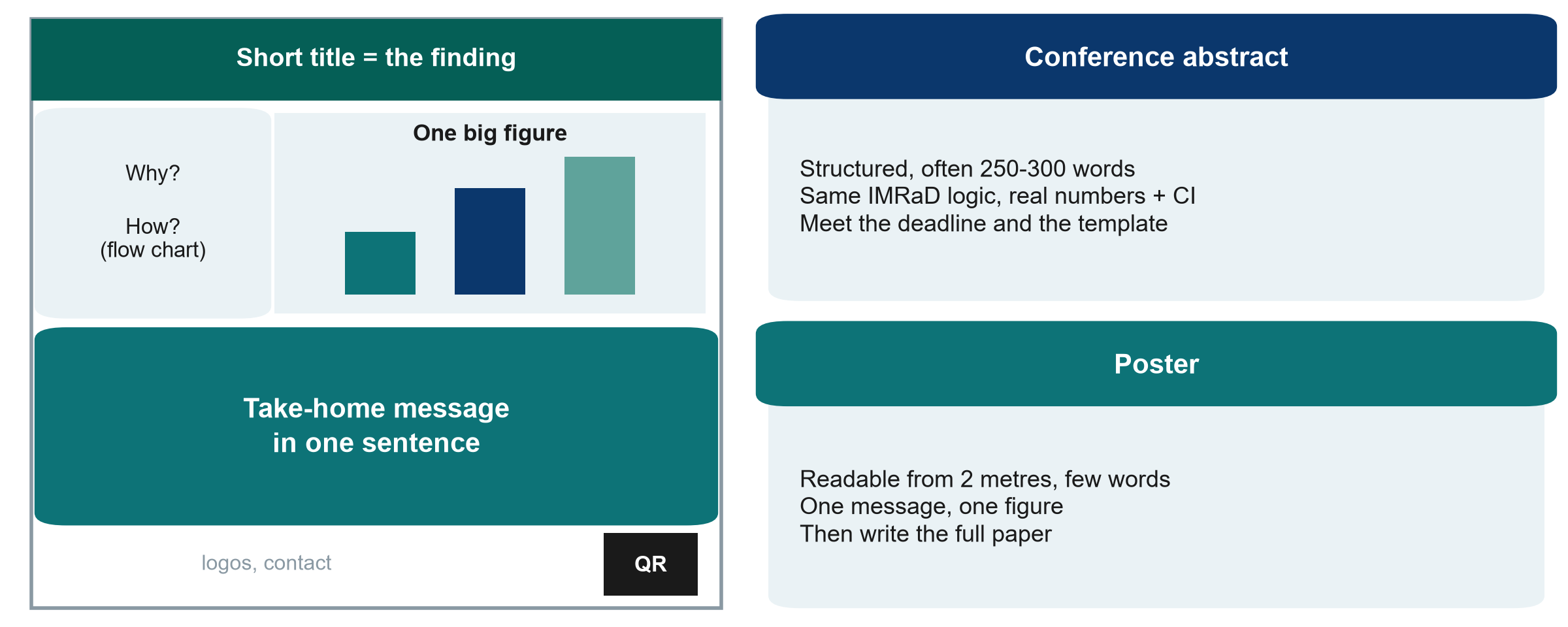
KEY MESSAGE A poster is a billboard: one message, one figure, readable from 2 metres.
From question to publication: what you can now do
Protect
- Ethics, consent, registration
- Honest data and authorship
Write
- IMRaD in the right order
- Numbers with CIs
- Verbs that match the design
Publish
- Reporting checklist
- Trusted journal
- Polite, complete responses
Review
- 10 questions
- What each design may claim
KEY MESSAGE Next: submit your proposal and your manuscript, then review one peer’s draft.
Closing: what you built and what happens next
Part 2
Session 8 · 22:15-22:30
- Post-course quiz (the same 24 questions)
- What you built in eight sessions
- Course evaluation
- After the course: submit, then review one peer’s manuscript
- Next steps
Post-course quiz
QUICK QUIZ · 8 min
- The same 24 questions as in Session 1, in an online form (link in the chat)
- Individual, no discussion
- Use the same participant code as in Session 1
- The answer key is shared after the course
OUTPUT Quiz submitted (participant code only)
What you built in eight sessions
Ask & find
- A PICO question
- 5 key references
- A working title
Design
- A justified design
- Outcomes
- A bias plan
Analyse
- A CRF and analysis plan
- The course dataset read and interpreted
Write
- Methods, Results
- Introduction, Discussion, Abstract
Publish
- Your own proposal
- Your own draft manuscript
KEY MESSAGE Each of you leaves with a research proposal and a draft paper.
Course evaluation
INDIVIDUAL TASK · 2 min
- Rate each session: content, pace, usefulness
- One thing to keep, one thing to change
- Interested in Level 2 (statistical modelling in R)?
OUTPUT Evaluation form submitted (anonymous)
After the course: peer review like real authors
Tonight
- Submit your complete draft by 23:59
- Course folder or email
2 days
- The course lead sends you one peer’s draft to review
Week 1
- Send your review report
- Use the 10-question checklist
Week 2
- Revised draft and response letter
- Use the response-to-reviewers template
KEY MESSAGE Individual homework: everyone reviews one draft and receives one review (Course/Assignment/peer_review_instructions).
What comes next
Your toolkit
- Slides, handouts, glossary
- Templates: proposal, protocol, consent form, case report form (CRF), analysis plan
- Templates: manuscript, response to reviewers
Keep going
- Take your proposal to the ethics committee
- Level 2: statistical modelling in R
- Level 3: advanced methods
Thank you!
Good questions. Sound designs. Honest analysis. Clear writing.
Copyright © Neudata, 2026
All property rights and copyright are reserved.
This presentation contains proprietary data, information, and materials developed by Neudata for dedicated use only and may not be communicated, copied, reproduced, distributed, published, or cited, in whole or in part, without the prior written consent of Neudata. Where explicit written permission has been granted, appropriate attribution must be included, followed by “by courtesy of Neudata”.
Any unauthorized use or infringement of these materials may give rise to legal action and claims for damages, without prejudice to any other rights of Neudata, including rights relating to patents, trademarks, or other forms of intellectual property protection.

Neudata | #ClearDataClearImpact