Session 7 · Protect & write: ethics, integrity, Methods and Results
Foundations of Clinical Research: From Clinical Question to Publication
Vương Mỹ Lượng & Bernard Osang’ir
Neudata Consulting Ltd

Session 7 · Protect & write: ethics, integrity, Methods and Results
Part 1
Week 7 · Saturday, 19:30-22:30 (online)
- 19:30 Recap: Session 6
- 19:40 7.1 Protocol, ethics, consent, registration, feasibility
- 20:10 7.2 Research integrity: authorship, conflicts of interest, data sharing, AI
- 20:30 Proposal builder 7: ethics and publication plan
- 21:00 7.3 Writing the paper (I): Methods, Results, tables, STROBE
- 21:35 Manuscript workshop 1: Methods and Results, together then on your own
Recap quiz: Session 6 in five questions
QUICK QUIZ · 8 min
- A crude OR (odds ratio) is 2.1. The adjusted OR is 1.4. What happened?
- HR (hazard ratio) 0.85, 95% CI 0.60 to 1.20: a clear benefit?
- Lactate is missing for 15% of patients. Name one way to handle it
- Kaplan-Meier curve: what does a ‘censored’ patient mean?
- The FLUID-ICU question you chose (Q1 to Q5): what is its main result? Answer in the chat
Answers
- Confounding: part of the crude link came from severity
- No: the CI includes 1
- Complete-case analysis, or multiple imputation with a sensitivity analysis
- Left the study alive. Outcome unknown after that
- From your results pack
OUTPUT Everyone re-activated: adjustment, CIs, missing data, survival
Today: finish the proposal, start the paper
FLUID-ICU = the course dataset: a simulated cohort of 620 adults with sepsis in 4 ICUs (Sessions 5-6).
Product 1: your proposal
- Your own question
- Today: Part 4 (ethics, registration, feasibility, publication)
- Session 8: submit it. About 5 people present
Product 2: your manuscript
- Your FLUID-ICU question (Q1 to Q5)
- We give the results. You write
- Today: Methods, Results
- Session 8: Introduction, Discussion, Abstract, Title
Our two example papers
- Paper 1: Boulet 2024, randomised trial, 48 patients
- Paper 2: Hyun 2023, cohort, 2,516 patients
- PDFs in Course/Papers
KEY MESSAGE Before the break: proposal Part 4. After the break: Methods and Results.
7.1 | 30 minutes
Protocol, ethics and consent
Protect the patient before the first data point
The protocol: your study’s building plan
Protocol = the full written plan of a study, approved before the first patient. Trial checklist: SPIRIT 2025.
Who and what
- Title page
- Title, version, date
- Registration number
- Team, roles, funding
Why
- Proposal Part 1
- Problem and rationale
- Question (PICO)
- Aim, objectives, hypothesis
How
- Proposal Parts 2-3
- Design, setting, participants
- Exposure, outcomes
- Sample size, data, analysis plan
Protect and share
- Proposal Part 4 (today)
- Ethics approval, consent
- Confidentiality, data safety
- Publication plan
KEY MESSAGE Your four proposal parts are the skeleton of a protocol.
Two rule books: Helsinki and Good Clinical Practice
Declaration of Helsinki (World Medical Association, 2024)
- Participants’ rights and well-being first
- Protocol approved by an ethics committee
- Free, informed consent
- Risks minimised and justified
- Privacy and confidentiality
- Register first, publish all results
Good Clinical Practice (GCP: ICH E6(R3), 2025)
- Qualified, trained team
- Quality built in by design
- Clear, feasible protocol
- Checks in proportion to the risk
- Reliable, traceable data
- Clear roles and responsibilities
KEY MESSAGE Helsinki says why we protect participants. GCP says how we run a trial well.
The ethics-committee journey: approval before data
Plan 1 to 3 months. Questions and revisions from the committee are normal.
Prepare
- Protocol
- Consent form
- Case report form (CRF)
Review
- Scientific or department review first
Submit
- Dossier to the research ethics committee
Decide
- Exempt, expedited or full committee
- The committee decides
Approve
- Approval letter with number and date
Start
- Trials: register first
- Then the first patient
KEY MESSAGE No approval letter, no data collection: not even ‘just a few patients’.
Register before the first participant
The order: protocol, ethics approval, registration, first participant.
Clinical trials
- Mandatory
- ClinicalTrials.gov or another who primary registry
- Paper 1: registered 1 July 2021, first patient September 2021
Systematic reviews
- Expected
- PROSPERO, the register for review protocols
- Before data extraction
Observational studies
- Recommended
- For example on ClinicalTrials.gov
- Check the journal and local rules
KEY MESSAGE Trials: no registration before the first patient, no publication.
Informed consent: four essentials
Consent is a conversation, not a signature.
Informed
- Purpose and what will happen
- Risks, benefits, alternatives
- How data are protected
- Who to contact
Understood
- Plain, local language
- Time to ask questions
- Teach-back: ‘tell me in your words’
Voluntary
- No pressure
- Free to refuse or withdraw
- Care is not affected
Documented
- Signed and dated form
- A copy for the participant
- Re-consent if the study changes
KEY MESSAGE If the patient cannot explain the study back to you, consent is not informed.
Consent in the ICU: when the patient cannot decide
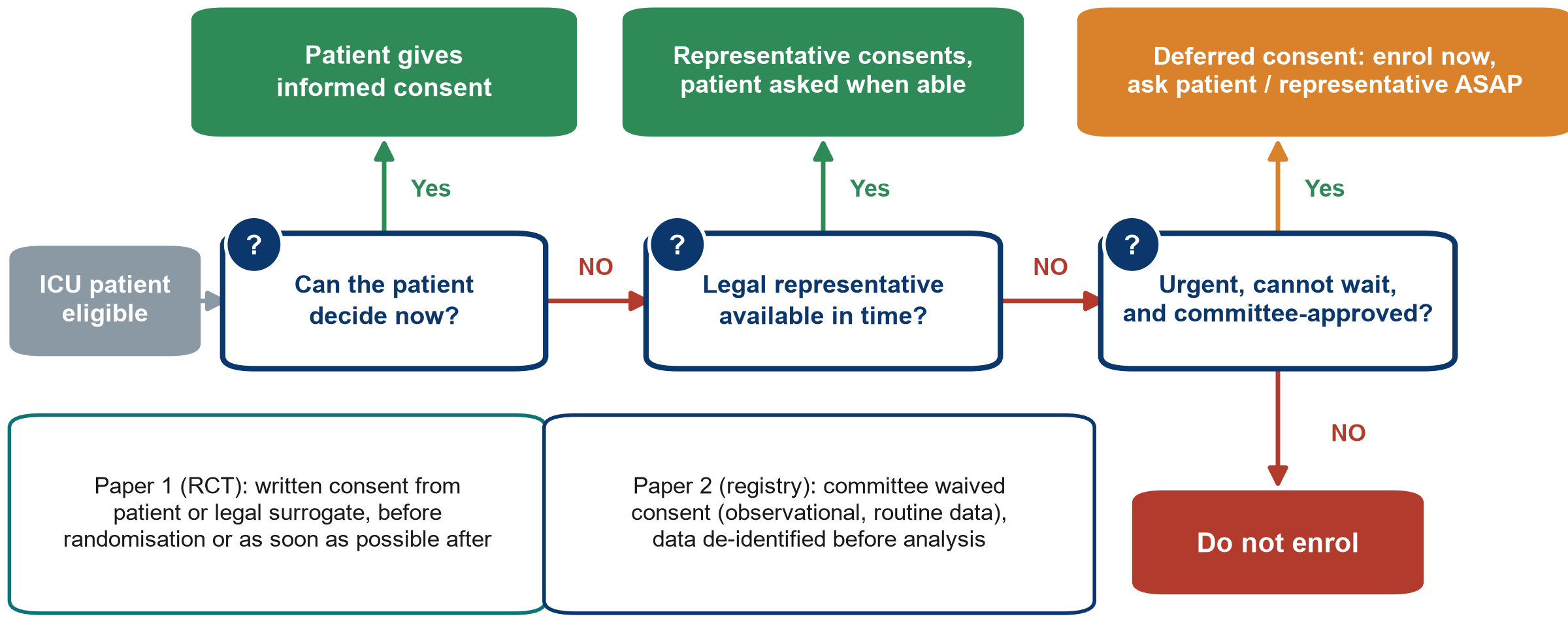
KEY MESSAGE Patient, then legal representative, then deferred consent (only if approved).
Worked example: who consents for these three ICU patients?
Walk each patient through the flowchart on the previous slide.
Mr A, 54
- Pneumonia, awake, oriented
- Eligible for a fluid trial
- Patient consents
Mrs B, 71
- Septic shock, sedated
- Daughter at the bedside
- Representative consents. Ask Mrs B when awake
Mr C, 38
- Septic shock at 03:00, no family yet
- Treatment cannot wait, committee approved
- Deferred consent: ask as soon as possible
KEY MESSAGE The pathway and the timing are written in the protocol before patient 1.
Confidentiality: de-identify before you analyse
| Item | Before: identifiable | After: de-identified |
|---|---|---|
| Name | Ana P. | Study code SEP-001 |
| Hospital number | 1084521 | Removed |
| Date of birth | 12/03/1956 | Age 68 |
| Admission date | 14/03/2024 | Month 03/2024 |
| Fluid balance, ml/kg | +35 | +35 |
Names stay on the ward. Only study codes travel. The key file (code = identity) is locked and kept separately. Beware very small groups (n < 5).
Worked example: the ethics paragraph for a cohort like FLUID-ICU
FLUID-ICU is simulated. If it were real, this is what the paper would say.
Approval
- Ethics committee of each ICU
- Approval number and date
- Before data collection
Consent
- Routine data, minimal risk
- Committee may waive consent (as in Paper 2)
Confidentiality
- Study codes only
- Key file kept in each ICU
- Data de-identified before analysis
Registration and sharing
- Registration recommended
- Data-sharing statement
- Data dictionary shared
KEY MESSAGE Your manuscript’s ethics paragraph answers four questions in four sentences.
Feasibility: five honest questions
Timeline
- Ethics alone: 1 to 3 months
- Recruitment takes longer than planned
- Draw a simple timeline (Gantt chart)
Budget
- Staff time
- Materials and tests
- Publication fee
People
- Who collects data at night?
- Who analyses?
- Protected time?
Recruitment
- Paper 1: 1201 screened, 50 randomised (4%)
- 17 months, 3 ICUs
Data
- Recorded routinely?
- How much will be missing?
- Paper 2: no diuretic data
KEY MESSAGE Count the eligible patients in your unit before you write the sample size.
7.2 | 20 minutes
Research integrity
Honest data, honest credit, honest use of AI
Research misconduct: fabrication, falsification, plagiarism
FFP = the three forms of research misconduct. An honest error is not misconduct: correct it openly.
Fabrication
- Making up data or patients
- Example: day-3 fluid balances entered ‘from memory’
Falsification
- Changing or leaving out data to fit the story
- Example: dropping two ‘odd’ patients who weaken the result
Plagiarism
- Using others’ words or ideas without credit
- Example: a copied paragraph, cited but without quotation marks
KEY MESSAGE Missing data are reported as missing: never invented, never quietly removed.
Also off-limits: tricks that distort the record
One study should tell one complete, honest story.
Duplicate publication
- Same results published twice
- The second paper does not say so
Salami slicing
- One study cut into thin papers
- Done to multiply publications
- The reader never sees the whole
Selective reporting
- Only the ‘significant’ outcomes reported
- Primary outcome switched after seeing the data
KEY MESSAGE Register first, pre-specify the primary outcome, report all of it.
Who is an author? The four ICMJE criteria
ICMJE = International Committee of Medical Journal Editors. An author meets all four.
1 Substantial work
- Idea, design, data, analysis or interpretation
2 Writing
- Drafted or critically revised the manuscript
3 Approval
- Approved the final version
4 Accountable
- Answers for all of the work
Not all four?
- Thank them in the Acknowledgements
- Gift author: named, did not do the work
- Ghost author: did the work, not named
KEY MESSAGE All four criteria, for every author. Decide the list at the start.
Conflicts of interest and funding: declare them all
Financial interests
- Consultancy, speaker fees
- Grants, travel support
- Shares, patents
- Employment
Non-financial interests
- Personal relationships
- Role in a guideline panel
- Strong prior beliefs
- Academic rivalry
Funding statement
- Who paid, grant number
- Role of the funder in design, analysis, writing and the decision to publish
- Paper 2: the funder had no role
KEY MESSAGE A declared interest is information. A hidden one is a scandal.
Data sharing: from ‘on request’ to open
From closed to open
- Not available
- ‘Available on reasonable request’ (Papers 1 and 2)
- Controlled-access repository
- Open repository with a DOI (permanent web identifier)
Before you share
- Consent form and ethics approval allow it
- Data de-identified
- Data dictionary and analysis code included
- Data-sharing statement in the paper
KEY MESSAGE Plan data sharing at the protocol stage: consent must allow it.
AI in research and writing: what is allowed
Allowed, with care
- Polish the language of your own text
- Brainstorm or summarise, then check every claim
- Disclose the tool, version and purpose
Never
- List AI as an author
- Paste patient data or a confidential manuscript into a public AI tool
- Let AI invent references, data or images
KEY MESSAGE Use AI like a junior assistant: check everything, disclose it, keep patient data out.
Integrity scenarios: green, amber or red?
QUICK QUIZ · 5 min
- Scenarios: Session 7 exercise sheet, Part A (PDF sent before the session), also on the shared screen
- Vote in the poll: green (fine), amber (fine only if fixed or disclosed) or red (misconduct)
- One or two volunteers explain their vote with the microphone on
- We do 3 scenarios together now. The other 3 are homework
Scenario 1
- Three day-3 fluid charts are lost. A resident enters the balances ‘from memory’.
- Your colour?
OUTPUT Everyone can name FFP, gift and ghost authorship, and the AI rules
Proposal builder 7: ethics, registration, feasibility, publication plan
PROPOSAL BUILDER · 15 min
- Watch: the instructor drafts Part 4 for the running example on the shared screen
- Consent: who consents, who asks, when? Two or three people answer with the microphone on (4 min)
- Registration and the key file: where? (3 min)
- Feasibility: the biggest risk and one fix (3 min)
- Publication plan: journal, reporting guideline, authors and roles (5 min)
Then, at home
- Write Part 4 for your own proposal
- Worksheet: Session 7 exercise sheet, Part B (PDF)
- Use the class example as a model
OUTPUT Part 4 modelled together. Your own Part 4 drafted at home this week

Break
15 min
7.3 | 35 minutes
Writing the paper (I): Methods and Results
Write what you did and what you found, nothing more
Write in a different order from the one readers read
Readers read: Title, Abstract, Introduction, Methods, Results, Discussion. Writers start from the data.
1 Tables
- Tables and figures: the story is in your data
2 Methods
- You know what you did
3 Results
- Describe your tables
4 Introduction
- Set up the question you answered
5 Discussion
- Answer, compare, explain
6 Abstract, title
- Summarise the paper, name it last
KEY MESSAGE Start with your tables. Write the title last.
Methods: enough detail for someone to repeat it
If a colleague could not redo your study from the Methods, add detail.
Who and where
- Design, setting, dates
- Eligibility criteria
- Ethics approval and consent
- Registration number
What was done
- Intervention or exposure in full
- Variables defined
- Paper 1: staff training, daily pharmacist check
Outcomes and size
- One primary outcome: how and when
- Sample size: assumptions and source
- Paper 2: no sample-size statement
Statistical analysis
- A method for each comparison
- Estimate matches the test
- Missing data, multiple comparisons
- Software and version
KEY MESSAGE The statistical paragraph names a method for every comparison you report.
Worked example: Methods for FLUID-ICU question 1
One sentence per STROBE item (simulated data). STROBE = the reporting checklist for observational studies.
- Items 4-6: We analysed FLUID-ICU, a prospective cohort of consecutive adults with sepsis admitted to four ICUs between January 2023 and December 2024.
- Item 7: The exposure was a positive cumulative fluid balance by ICU day 3 (fluid in minus fluid out over days 1-3, > 0 ml/kg). The outcome was death from any cause within 28 days of ICU admission.
- Item 8: Data came from ICU charts on a standard case report form.
- Item 9: To address confounding by indication, we adjusted for severity and comorbidity pre-specified in the analysis plan.
- Item 10: All eligible patients in the cohort were included (no separate sample size).
- Ethics (course version): This analysis used a simulated teaching dataset. No ethics approval or consent was required.
Worked example: the statistical-analysis paragraph
STROBE item 12 for Q1: one sentence per decision, all chosen before seeing the data.
- Baseline characteristics: mean (SD), median (IQR) or n (%), by balance group.
- 28-day mortality: chi-square test. Crude and adjusted odds ratios from logistic regression (age, SOFA score, lactate, vasopressor, mechanical ventilation, chronic kidney disease).
- Time to death: Kaplan-Meier curves (log-rank test) and Cox regression with the same covariates. Proportional hazards checked.
- Effect modification by heart failure: an interaction term (pre-specified).
- Main analysis on complete cases. Missing lactate (15%) handled by multiple imputation (20 data sets) as a sensitivity analysis.
- Estimates with 95% confidence intervals. Analyses in R 4.6.
Results: report, do not interpret
1 Participants first
- Screened, included, analysed, and why some were lost
- Paper 1: 1201 screened, 50 randomised, 48 analysed
2 Numbers with CIs
- Effect size with its 95% confidence interval (CI)
- Not ‘p = 0.42, not significant’
3 No interpretation
- Results report, the Discussion interprets
- Paper 2: results in the order of the aims
4 One home per number
- Key numbers in the text, details in the tables
- Paper 1: text and Table 1 disagree on creatinine
KEY MESSAGE Participants first, then each outcome as an effect size with its 95% CI.
Worked example: Results for FLUID-ICU question 1
Participants, Table 1, outcome numbers, crude and adjusted estimates (simulated data).
- Item 13: Of 620 patients enrolled, 618 had a day-3 fluid balance and were analysed, 527 had complete data for the adjusted model.
- Item 14: 373 (60.4%) had a positive balance. They were sicker: median SOFA 8 vs 6. Vasopressors 55.0% vs 24.9% (Table 1).
- Item 15: By day 28, 134 of 373 (35.9%) patients with a positive balance and 45 of 245 (18.4%) with a negative balance had died.
- Item 16: Crude OR 2.49 (95% CI 1.70 to 3.70), adjusted OR 1.62 (95% CI 1.02 to 2.59).
- Item 17: Multiple imputation: adjusted OR 1.70 (1.09 to 2.64). Adjusted Cox HR 1.46 (1.00 to 2.13).
- No ‘because’, no ‘significant’, no ‘suggests’: numbers with 95% CIs only.
Tables and figures that stand alone
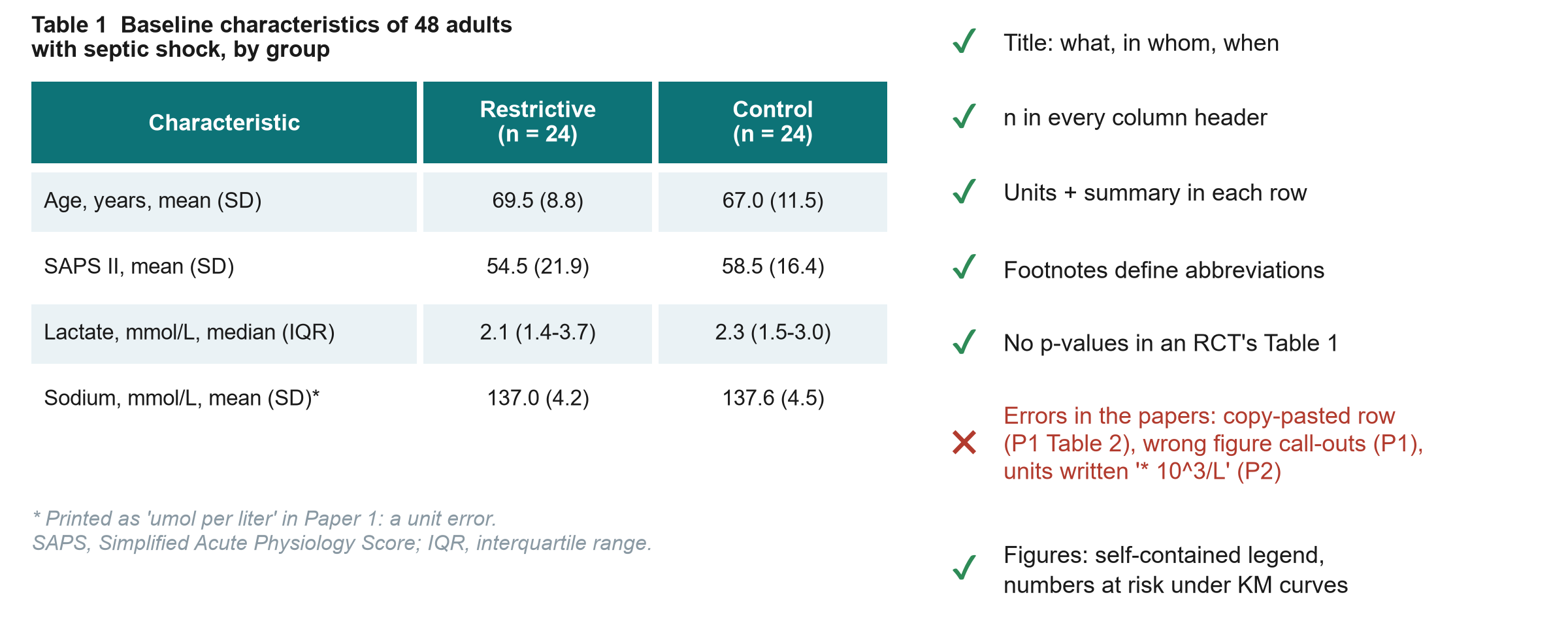
KEY MESSAGE A reader should understand each table without reading the text.
Worked example: FLUID-ICU Table 1 in one sentence
| Characteristic | Negative balance (n = 245) | Positive balance (n = 373) |
|---|---|---|
| Age, years, mean | 64.6 | 61.4 |
| SOFA score, median (IQR) | 6 (4 to 8) | 8 (6 to 10) |
| Vasopressor, n (%) | 61 (24.9%) | 205 (55.0%) |
| Mechanical ventilation, n (%) | 97 (39.6%) | 216 (57.9%) |
| Lactate, mmol/L, median (IQR) | 2.2 (1.4 to 3.0) | 2.9 (1.9 to 4.0) |
| Heart failure, n (%) | 54 (22.0%) | 43 (11.5%) |
Simulated data (results pack Q1, Table 1). SOFA = organ failure score. IQR = interquartile range. Sentence: ‘Patients with a positive balance were sicker at baseline.’
STROBE for the FLUID-ICU paper: which item goes where
FLUID-ICU is a cohort, so the paper follows STROBE. Numbers are STROBE item numbers.
Methods (items 4-12)
- 4 Design
- 5 Setting, dates
- 6 Participants
- 7 Variables
- 8 Data sources
- 9 Bias
- 10 Study size
- 12 Statistics, missing data
Results (items 13-17)
- 13 Participants and flow
- 14 Descriptive data (Table 1)
- 15 Outcome data
- 16 Main results: crude and adjusted, 95% CI
- 17 Other analyses
KEY MESSAGE Write with the STROBE checklist open and tick each item as you write it.
Check: Methods, Results or Discussion?
QUICK QUIZ · 3 min
- ‘We used logistic regression adjusted for SOFA score and age.’
- ‘Of 620 patients enrolled, 618 had a day-3 fluid balance.’
- ‘This may be because sicker patients received more fluid.’
- ‘Lactate was missing in 15.0% of patients and was imputed.’
- ‘28-day mortality was higher with a positive balance (adjusted OR 1.62, 95% CI 1.02 to 2.59).’
Answers
- Methods
- Results (participants)
- Discussion (explains)
- Methods (how) and Results (how many)
- Results
Manuscript workshop 1 | 45 minutes
Write the Methods and Results: together, then on your own
30 minutes drafting Q1 live with the whole class, then 15 minutes on your own question
Manuscript workshop 1, part 1: we draft Q1 together
WHOLE-CLASS TASK · 30 min
- The instructor shares the manuscript template and results pack Q1
- Methods (15 min): you suggest each sentence aloud when called on. The instructor types the best one
- Results (12 min): participants, Table 1 sentence, crude and adjusted OR
- Number check (3 min): a volunteer reads each number against the pack
Use
- Results pack Q1 (sent before the session)
- Manuscript template (Course/Templates)
- STROBE items 4-17
- The worked examples (slides)
OUTPUT A class draft of the Q1 Methods and Results, shared as a PDF after the session
Manuscript workshop 1, part 2: start your own draft
INDIVIDUAL TASK · 15 min
- Open the results pack for your question (Q1 to Q5)
- Follow the structure of the class draft. Take every number from your pack
- Start with the Methods: design, participants, variables, statistics
- Questions: raise your hand or use the chat. The instructor answers
- At home: finish the Methods and Results, Table 1 and one figure or table
The five questions
- Q1 Fluid balance and 28-day death
- Q2 Fluid balance and AKI (acute kidney injury)
- Q3 Fluid balance and ventilator-free days
- Q4 Lactate, death and missing data
- Q5 Fluid balance and ICU stay (survivors)
OUTPUT Your own Methods and Results (about 600 words), sent to the course folder before Session 8
Key words of Session 7
| Term | In plain words |
|---|---|
| Deferred consent | Enrol first in an emergency, ask consent as soon as possible (committee-approved) |
| Registration | Public record of a study before patient 1 (mandatory for trials) |
| FFP | Research misconduct: fabrication, falsification, plagiarism |
| ICMJE criteria | The four conditions every author must meet |
| Conflict of interest | Anything that could be seen to influence your judgement. Declare it |
| STROBE | Reporting checklist for observational studies: Methods items 4-12, Results 13-17 |
Full glossary (English-Vietnamese): Course/References/glossary_EN_VN (PDF in the course folder)
Wrap-up, exit question and homework
DISCUSSION · 7 min
- Three take-home messages (right)
- Exit question in the chat: ‘Who consents for a sedated patient in septic shock, and when?’
- Homework 1: write Part 4 of your own proposal
- Homework 2: finish your Methods and Results draft before Session 8
- Homework 3: prepare your 6 presentation slides (everyone submits them)
Take home
- No approval, no data: not even ‘a few patients’
- Every author meets all four criteria. Declare every interest
- Methods = what you did. Results = numbers with CIs, no opinions
OUTPUT Exit answers read before Session 8. Part 4 and Methods + Results drafted
Extra slides | Session 7
Extra slides: Session 7
Use only if time allows, or for self-study
Check: register or not?
QUICK QUIZ · 2 min
- A randomised trial of restrictive vs usual fluids in septic shock
- A systematic review of fluid strategies in sepsis
- A retrospective cohort from ICU charts (like FLUID-ICU)
- A clinical audit of fluid-balance charting against the unit standard
Answers
- Must: a trial registry, before patient 1
- Should: PROSPERO
- Recommended, not required
- Audit: no research registration, local approval
IMRaD: the hourglass shape of every paper
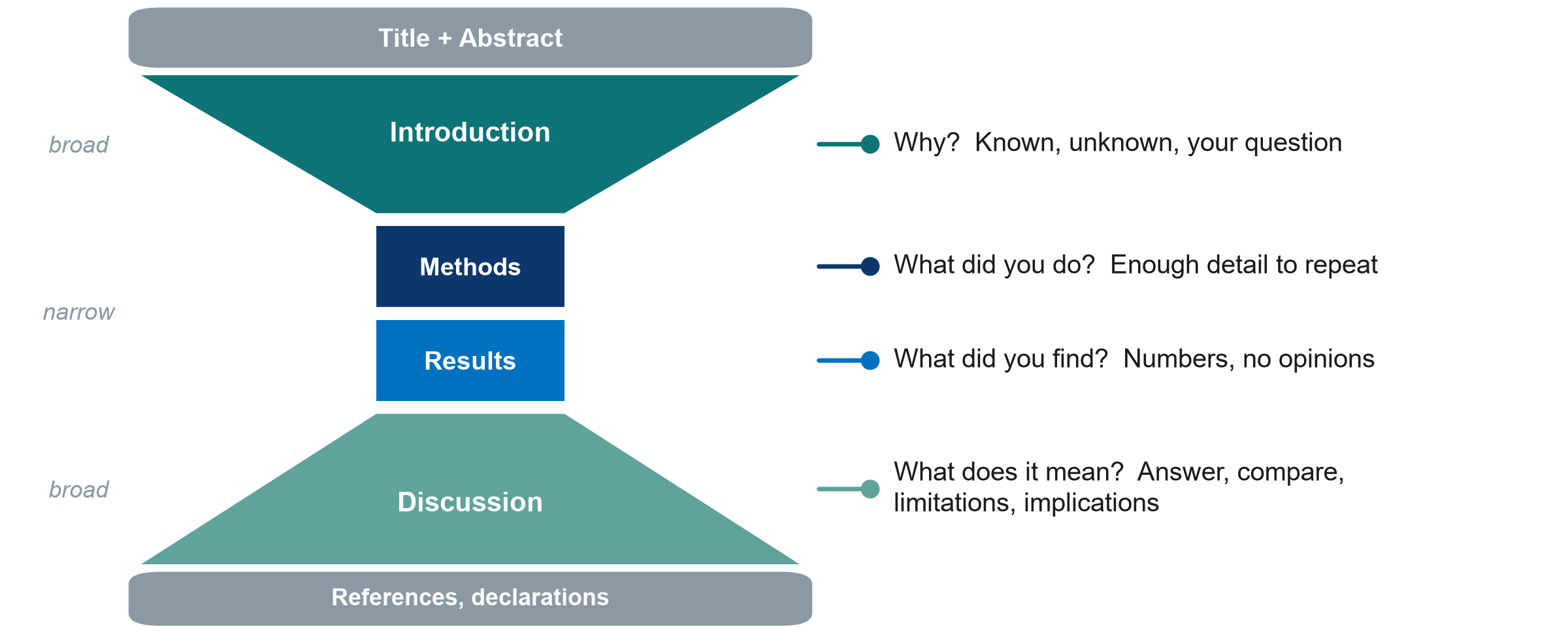
KEY MESSAGE Introduction narrows to your question. Discussion widens back to practice.
CRediT: say who did what
CRediT (Contributor Roles Taxonomy): 14 standard roles that journals now ask for.
Some of the 14 roles
- Conceptualization
- Methodology
- Investigation
- Formal analysis
- Writing (original draft)
- Writing (review and editing)
- Supervision
Paper 1 did it
- NB: Writing (original draft)
- CS: Methodology, Formal analysis
- SDB: Conceptualization, Supervision, Funding acquisition
Your proposal
- Agree the author list now
- Write each person’s roles
- Revisit before submission
KEY MESSAGE Transparent roles prevent gift and ghost authorship.
Copyright © Neudata, 2026
All property rights and copyright are reserved.
This presentation contains proprietary data, information, and materials developed by Neudata for dedicated use only and may not be communicated, copied, reproduced, distributed, published, or cited, in whole or in part, without the prior written consent of Neudata. Where explicit written permission has been granted, appropriate attribution must be included, followed by “by courtesy of Neudata”.
Any unauthorized use or infringement of these materials may give rise to legal action and claims for damages, without prejudice to any other rights of Neudata, including rights relating to patents, trademarks, or other forms of intellectual property protection.

Neudata | #ClearDataClearImpact