Session 2 · Find & read: the evidence
Foundations of Clinical Research: From Clinical Question to Publication
Vương Mỹ Lượng & Bernard Osang’ir
Neudata Consulting Ltd

Session 2 · Find & read: the evidence
Part 1
Week 2 · Saturday
- Recap quiz on Session 1
- 2.1 Finding the evidence: PICO to search, Boolean, MeSH, live PubMed demo
- 2.2 Managing and citing: Zotero demo, citation styles, paraphrasing, grey literature
- Break
- 2.3 Reading a paper in 15 minutes and 2.4 from literature to introduction
- Proposal builder 2: your own search, 5 references, problem statement, working title
Recap quiz: Session 1
QUICK QUIZ · 8 min
- Which course paper is a trial and which is a cohort: Paper 1 (Boulet) or Paper 2 (Hyun)?
- ‘In adults with sepsis, is a positive fluid balance by day 3, vs not, linked to death by day 28?’ Name P, E, C, O, T
- Which FINER letter did our running example fail?
- Which is an objective: ‘to understand fluid balance’ or ‘to estimate the proportion fluid-positive on day 3’?
- Write H0 for: does a restrictive protocol reduce fluid balance at day 5?
OUTPUT Answers in the online quiz form (link in the chat), checked against the next slide
Recap quiz: answers
Designs
- Paper 1 is a trial (RCT)
- Paper 2 is a cohort
PECO(T)
- P: adults with sepsis
- E: positive balance by day 3
- C: neutral or negative balance
- O and T: death by day 28
Feasible
- Mortality needs more than 1,000 patients
Estimate
- ‘Estimate’ is measurable
- ‘Understand’ is not
H0
- Fluid balance at day 5 is the same in both groups
KEY MESSAGE If you got 4 or 5 right, you are ready for today.
2.1 Finding the evidence
Before you study it, find out what is already known.
40 minutes: the search funnel, PICO to search blocks, Boolean, MeSH, search tools, checking for a systematic review and a live PubMed demo
The search funnel
Write down each step: the date, the search string, the filters and the number of hits.
All of PubMed
- More than 40 million records
- As of October 2026
One keyword
- septic shock
- Tens of thousands
PICO blocks
- MeSH and free text, AND and OR
- A few thousand
Filters
- RCT, review, adults, years
- Hundreds
Screen
- Read titles and abstracts
- Dozens
Keep
- 5-10 key papers
KEY MESSAGE A good search starts wide, narrows step by step, and is written down.
From PICO to search blocks
OR inside a block, AND between blocks: (P synonyms) AND (I synonyms) AND (O synonyms). C (usual care) is usually not searched.
P: septic shock
- “Shock, Septic”[MeSH]
- OR “septic shock”[tiab]
- OR sepsis[tiab]
I: restrictive fluids
- “Fluid Therapy”[MeSH]
- OR “fluid restrict*”[tiab]
- OR “restrictive fluid*”[tiab]
- OR “conservative fluid*”[tiab]
O: mortality
- Mortality[MeSH]
- OR mortality[tiab]
- OR death[tiab]
KEY MESSAGE One block per PICO concept: OR inside a block, AND between blocks.
Another example: a ward question
Question: in adults at risk on the ward, does 2-hourly repositioning reduce new pressure injuries?
P + O: pressure injury
- “Pressure Ulcer”[Mesh]
- OR “pressure injur*”[tiab]
- OR “pressure ulcer*”[tiab]
- OR bedsore*[tiab]
I: repositioning
- “Patient Positioning”[Mesh]
- OR reposition*[tiab]
- OR turning[tiab]
Join the blocks with AND
- Tip: when P and O are the same idea (pressure injury), one block can carry both.
- Authors write ulcer, injury, bedsore, decubitus. MeSH collects them under “Pressure Ulcer”.
KEY MESSAGE Same method for any topic: concepts in blocks, synonyms with OR, blocks with AND.
Boolean logic in pictures
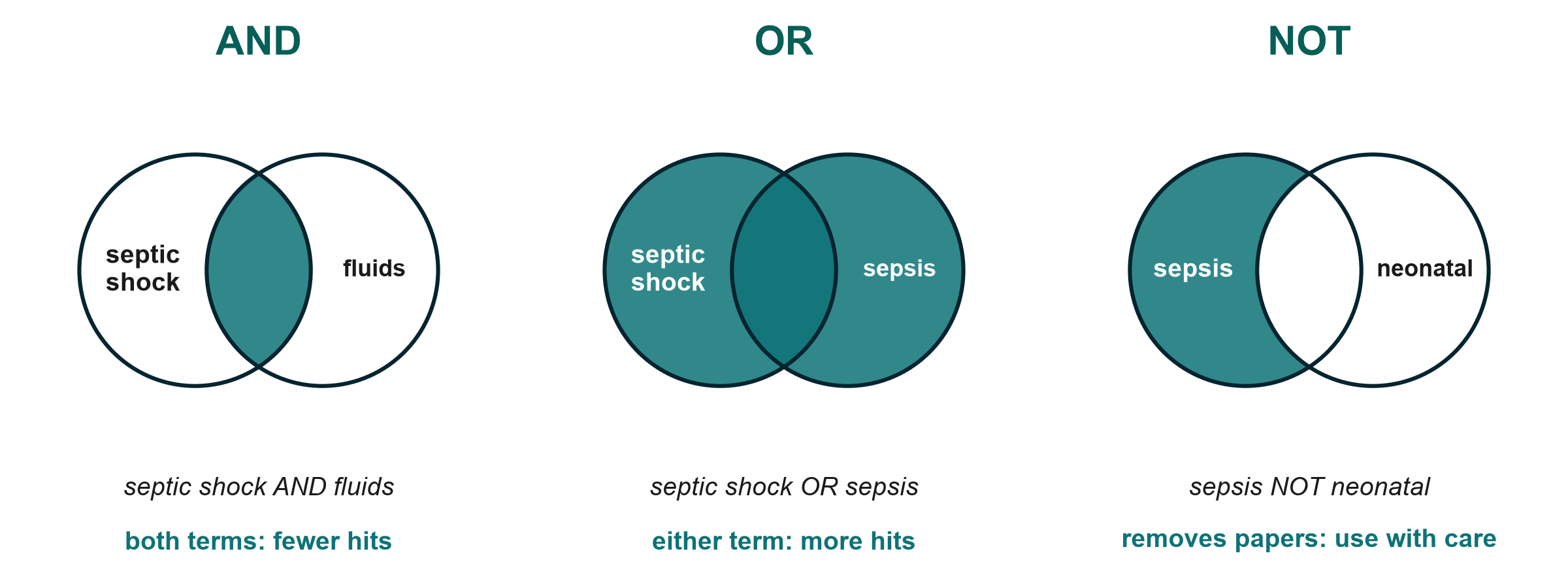
KEY MESSAGE AND narrows, OR widens, NOT removes. Use NOT sparingly.
Check your understanding: AND, OR or NOT?
QUICK QUIZ · 2 min
- You want papers that mention both septic shock and fluid restriction: which operator?
- You want papers using either ‘restrictive’ or ‘conservative’ fluids: which operator?
- Your search found 40,000 hits. Will adding a third AND block give more or fewer?
- Why is ‘sepsis NOT children’ risky?
OUTPUT Answers in the chat (or the poll)
MeSH: the shared label behind many words
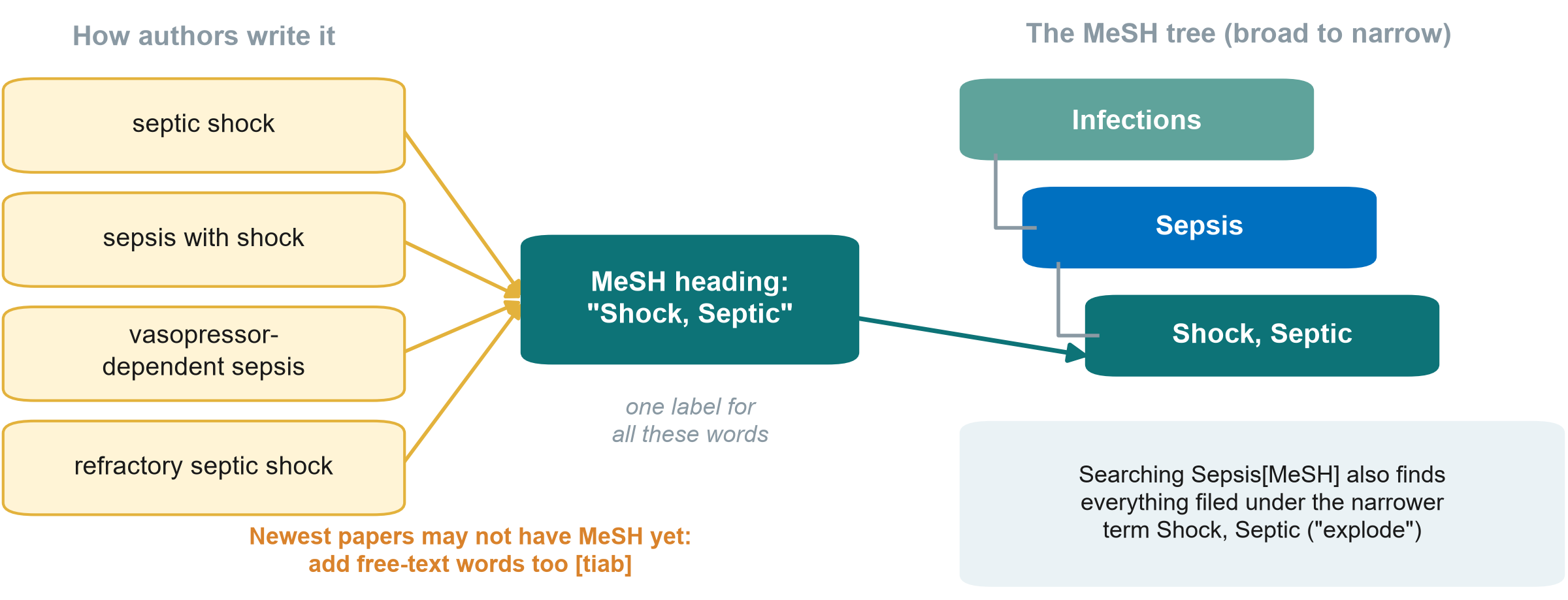
KEY MESSAGE Search the MeSH term AND the free-text words, joined with OR.
How to find the right MeSH term
MeSH Database
- PubMed home page, under Explore
- Type a word, e.g. bedsore
- It shows the heading: Pressure Ulcer
A paper you trust
- Open a relevant paper in PubMed
- Scroll down to ‘MeSH terms’
- Reuse the ones that fit
Search details
- PubMed maps your words to MeSH
- Check which heading it used
KEY MESSAGE Look up MeSH terms, do not guess them.
Four tools that sharpen a search
“Quotes”
- “septic shock” = the exact phrase
- Not two loose words
Truncation *
- child* finds child, children, childhood
- Use it when one idea has many word endings
Field tags
- [tiab] title or abstract
- [mh] MeSH term
- [pt] article type
Filters
- Article type (RCT, systematic review)
- Date, age, humans
KEY MESSAGE Check ‘Search details’ to see exactly what PubMed searched.
PubMed vs Google Scholar
| PubMed | Google Scholar |
|---|---|
| What it covers | Biomedical journals, indexed by experts |
| MeSH (controlled vocabulary) | Yes |
| Filters (design, age, date) | Yes, many |
| Transparent, repeatable | Yes |
| “Cited by” a key paper | Partial |
| Best for | Your main, repeatable search |
KEY MESSAGE PubMed for the main search. Google Scholar to check and to follow citations.
First check: is there already a systematic review?
Search for reviews
- Cochrane Library
- PubMed filter: Systematic Review
Reviews in progress
- PROSPERO lists registered systematic reviews
Then decide
- A recent, good review: build on it
- None, or out of date: that is a gap
Learn to do one
- Level 3, Module A: systematic review and meta-analysis
KEY MESSAGE Before you plan a study, find out what has been done, starting with systematic reviews.
Live demo: searching PubMed for our question
LIVE DEMO · 10 min
- Search one keyword, septic shock, and note the number of hits
- Paste the full PICO string: P, I and O blocks joined with AND
- Look at ‘Search details’: what did PubMed really search?
- Add filters: RCT and systematic review, adults, last 10 years
- Open one result: abstract, MeSH terms, ‘Similar articles’, ‘Cited by’
- Click ‘Send to’, then ‘Citation manager’ (we import it in 2.2)
Watch for
- How the hits fall at each step
- Which papers keep appearing
- Can you find Paper 1 and the CLASSIC trial (Meyhoff 2022)?
OUTPUT A search string we can all copy (Exercise 1 on the sheet)
Your turn: build a Boolean search
INDIVIDUAL TASK · 5 min
- Take your own PICO question and your synonym list (Session 1 homework)
- Exercise 1: write 2-4 synonyms for P, for I (or E) and for O
- Join synonyms with OR in brackets, and the blocks with AND
- Check which words are MeSH terms: MeSH Database or a known paper
- We call on 2-3 people to read their string aloud, microphone on
OUTPUT One search string for your own question, to run in Proposal builder 2
2.2 Managing and citing
Keep every reference you find, and use other people’s work honestly.
20 minutes: reference managers (Zotero demo), citation styles, paraphrasing safely, grey literature
Reference managers: save as you go
Collect
- Tick papers in PubMed
- Clipboard or My NCBI Collections
Export
- ‘Send to’, then ‘Citation manager’
- Gives an .nbib file
Import
- Zotero or Mendeley (free)
- EndNote (paid)
Cite
- Insert citations in Word with the plug-in
List
- Reference list built for you
- Any style
KEY MESSAGE A reference manager prevents the commonest error in proposals: wrong references.
Live demo: from PubMed to Zotero to Word
LIVE DEMO · 5 min
- Import the .nbib file from the PubMed demo into Zotero
- Look: authors, title, journal, year, DOI, with nothing typed by hand
- In Word, on the Zotero tab, click ‘Add/Edit Citation’ and type Meyhoff
- Click ‘Add/Edit Bibliography’: the reference list appears
- Open ‘Document Preferences’: switch Vancouver to APA and back
Watch for
- [1] becomes (Meyhoff et al., 2022)
- The list reformats itself
OUTPUT Everyone has seen the full cycle: collect, cite, list
Citation styles: same paper, two looks
Use the style your target journal asks for. The reference manager switches in one click.
Vancouver
- Restricting IV fluid did not change 90-day mortality [1].
- Reference list:
- Author AA, Author BB, et al. Title. J Abbrev. Year;Vol(Issue):pages.
- Numbered in the order cited. Used by most medical journals.
APA
- Restricting IV fluid did not change 90-day mortality (Meyhoff et al., 2022).
- Reference list:
- Author, A. A., & Author, B. B. (Year). Title. Journal, Vol(Issue), pages.
- Author and year in the text. Common in nursing and social science.
KEY MESSAGE Pick the style your target journal uses, and let the software do the formatting.
Citing vs copying: paraphrase safely
Method: read, close the paper, write from memory, check facts, cite.
Source (Boulet et al. 2024, abstract)
- “In ICU patients with septic shock, an optimized restrictive fluid strategy targeting hidden fluid intakes did not reduce the overall fluid balance at day 5.”
Word swaps (“patchwriting”)
- “In septic shock ICU patients, an optimised restrictive approach targeting hidden fluid intakes did not lower the total fluid balance at day 5.”
- Same structure, same words = plagiarism, even with a reference
Own words + citation
- “A pilot trial in 48 patients found that limiting maintenance and drug-dilution fluids did not significantly change fluid balance after five days [1].”
- New structure, adds context, cited
KEY MESSAGE Change the structure as well as the words, and always cite the source.
Four rules for citing safely
Cite facts
- Numbers, findings and others’ ideas need a citation
Cite sources
- Read and cite the original paper
- Not a summary of it
Own words
- Use a new structure
- Exact words only in quotation marks
Check
- Every reference says what you claim it says
KEY MESSAGE Never cite a paper you have not read.
Check your understanding: OK or not OK?
QUICK QUIZ · 2 min
- You copy a sentence from an abstract, change two words and add [3]
- You quote one sentence word for word, in quotation marks, with [3]
- You write a finding in your own words but forget the citation
- You cite a paper you found quoted in a review, without reading it
OUTPUT For each: a thumbs-up (OK) or thumbs-down (not OK) reaction, or the poll
Grey literature, including trial registries
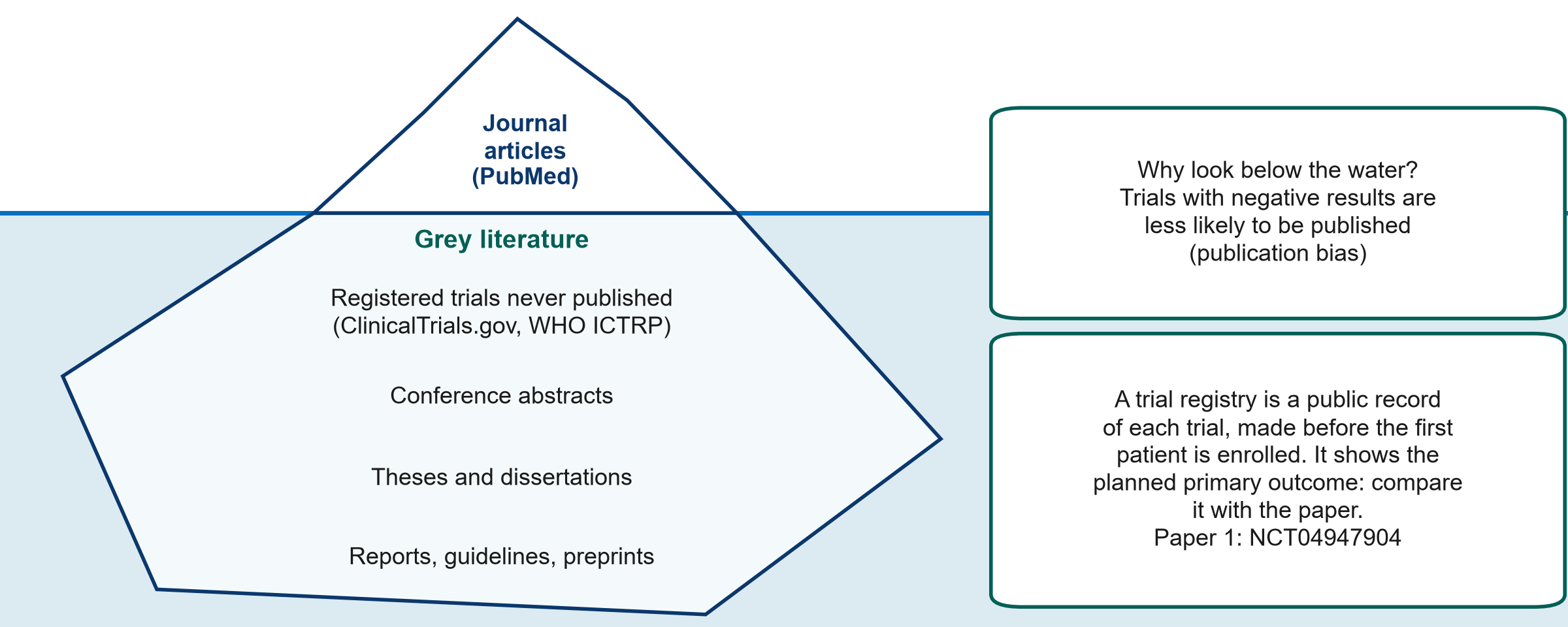
KEY MESSAGE Look below the waterline: searching grey literature, including trial registries, reduces publication bias.

Break
15 min
2.3 Reading a paper in 15 minutes
You do not have to read every word. Read the right words in the right order.
40 minutes: anatomy of a paper, reading order, the abstract, spin, and a reading task on Paper 1
Anatomy of a paper: IMRaD
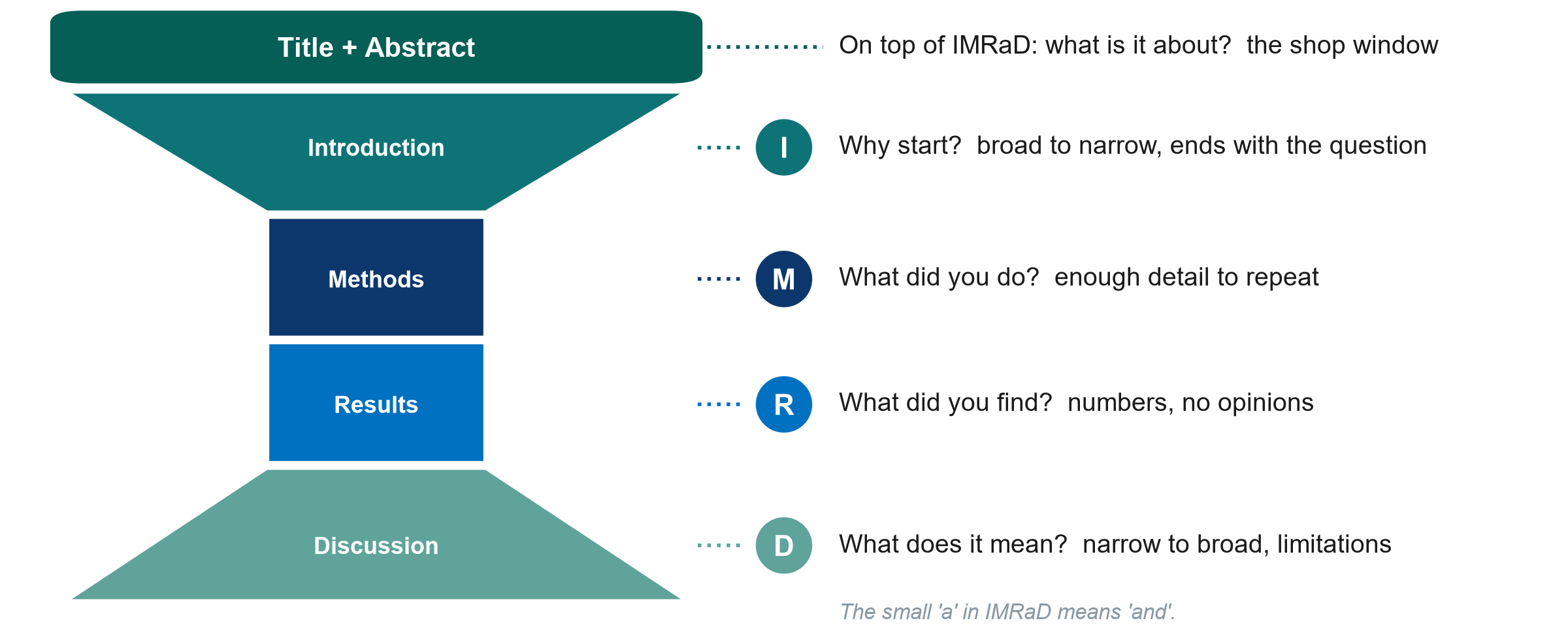
KEY MESSAGE Every original paper has the same shape: why, how, what, so what.
The 15-minute reading order
Stop after step 1 or 2 if it does not answer your question. Total: about 15 minutes.
1 Title
- 30 s
- Relevant to my question?
2 Abstract
- 3 min
- PICO, design, main result
3 Figures and tables
- 4 min
- Flow chart, Table 1, main result table
4 Methods
- 5 min
- Who, how chosen, primary outcome, bias protection
5 Discussion
- 2-3 min
- Limitations. Do conclusions match the data?
KEY MESSAGE Title, abstract, figures and tables, methods. Stop early if it is not relevant.
What an abstract must contain
| Section | What it must contain |
|---|---|
| Background | The problem and the aim (1-2 sentences) |
| Methods | Design, setting, participants, intervention/exposure, comparison, primary outcome |
| Results | Numbers screened and analysed, primary result as effect size + 95% CI (+ p), key harms |
| Conclusions | Answer to the primary question, no more |
| Registration | Trial registry number (for trials) |
Usually 250-300 words
KEY MESSAGE A good abstract lets you write the PICO and the main result without opening the paper.
A results sentence: poor vs good
Illustrative numbers. Ask of every abstract: how big, how sure, by when?
Poor results sentence
- “Mortality was significantly lower in the intervention group (p < 0.05).”
- No numbers per group
- No effect size
- No 95% CI
- No time point
Good results sentence
- “28-day mortality was 30% with restriction vs 38% with usual care (risk difference -8 percentage points, 95% CI -15 to -1).”
- Numbers per group
- Effect size
- 95% CI
- Time point
KEY MESSAGE Every main result needs: numbers per group, an effect size, a 95% CI and a time point.
Spin: when words go beyond the data
| What the data say | What the words say (spin) | Seen in |
|---|---|---|
| p-value | p = 0.42 | “a non-significant trend” |
| Outcomes | Primary outcome: no difference | Headline = a positive secondary outcome |
| Design | Observational association | “Impact of…”, “reduces” |
| Comparison | No between-group test | “Patients improved” (before vs after only) |
KEY MESSAGE Read the numbers first, then check whether the words match them.
Check your understanding: spot the spin
QUICK QUIZ · 3 min
- A cohort study: ‘A positive fluid balance increases deaths in sepsis’
- Primary outcome p = 0.31: ‘a promising trend towards benefit’
- The primary outcome shows no difference, but the abstract headline says ‘improved patient satisfaction’
- ‘Mortality fell from 30% to 22% after our new fluid protocol’ (no control group)
OUTPUT For each, we call on 2-3 people, microphone on: what is the spin, and how would you rewrite it?
Your turn: read Paper 1’s abstract
INDIVIDUAL TASK · 12 min
- Open Paper 1 (Boulet 2024, Crit Care): the abstract is on page 1
- Fill the reading grid (Exercise 3): design, P, I vs C
- Primary outcome, numbers screened and analysed
- Main result with its 95% CI and p-value
- Does the conclusion match the result? Any spin?
- Type your primary outcome and main result in the chat
Clock
- 8 minutes reading alone
- 4 minutes checking in the chat
OUTPUT A completed abstract reading grid
Paper 1’s abstract: the answers
| Abstract item | What Paper 1 reports |
|---|---|
| Design | Pilot RCT, single-blind (patients and statisticians), 3 ICUs |
| P | Adults 18-85 y, septic shock, first 24 h of vasopressors |
| I vs C | Restrict maintenance and drug-dilution fluids (7 days) vs standard |
| Primary outcome | Cumulative fluid balance at day 5 (ml/kg) |
| Numbers | 1,201 screened, 50 randomised, 48 analysed (24 per group) |
| Main result | Median 6.9 vs 35.0 ml/kg. Difference 13.2 (95% CI -15.2 to 41.6), p = 0.42 |
| Conclusion | Did not reduce fluid balance at day 5 (matches the result) |
| Registration | ClinicalTrials.gov NCT04947904 |
KEY MESSAGE Primary outcome: fluid balance, not mortality. Read what the study actually measured.
2.4 From literature to introduction
The papers you read become the first page of your proposal.
15 minutes: the literature matrix, the problem-statement funnel, a model problem statement, working title and keywords
The literature review worksheet
| Study | Design, size | Compared | Primary outcome: result | Key limitation |
|---|---|---|---|---|
| Boulet 2024 Crit Care | Pilot RCT, 3 ICUs, n = 48 | Restrict hidden fluids vs standard | Fluid balance at day 5: no significant difference | Small, not powered for mortality |
| Hyun 2023 Ann Intensive Care | Matched cohort, registry, 20 hospitals | Positive vs negative fluid balance | 28-day death higher if positive by day 2-3 | Observational: confounding possible |
| Meyhoff 2022 N Engl J Med | Large RCT (CLASSIC), n = 1,554 | Restrictive vs standard IV fluid | 90-day death 42.3% vs 42.1%: no difference | Clinicians not blinded |
| Your paper 4 | … | … | … | … |
KEY MESSAGE One row per paper: 5 rows today, the same columns for every paper.
From literature to your Introduction
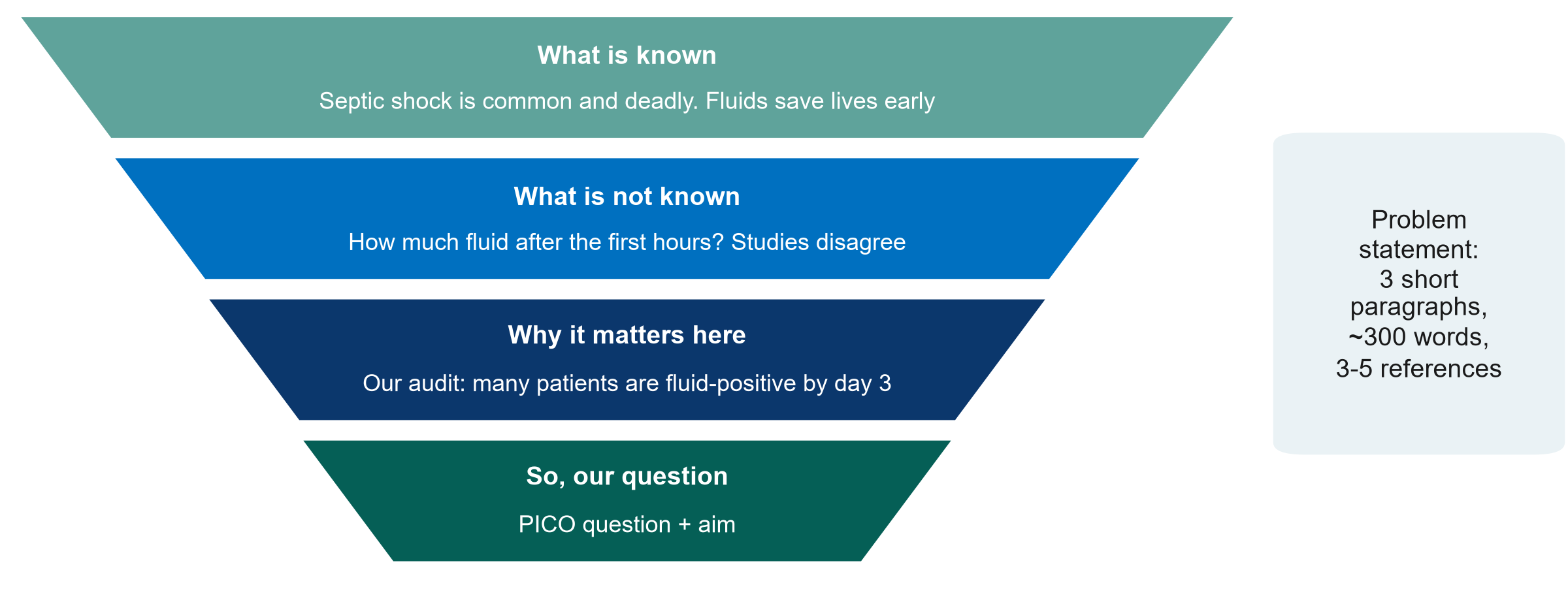
KEY MESSAGE Known, not known, why here: the question then follows naturally.
A model problem statement
| Paragraph | Model text |
|---|---|
| 1 What is known | Septic shock is a leading cause of ICU death. Early fluids restore perfusion, but continued fluids often produce a positive fluid balance, which cohort studies associate with higher mortality [2]. |
| 2 What is not known | Large trials of restrictive fluids found no mortality difference [3, 4], and a pilot targeting hidden fluids did not significantly reduce fluid balance [1]. Whether restriction is achievable in our setting is unknown. |
| 3 Why it matters here | Our 3-month audit found that most septic shock patients were fluid-positive by day 3, and practice varies between consultants. We therefore ask: [PICO question]. |
Model text: replace the audit numbers with your own
KEY MESSAGE Three short paragraphs, each with its own job, and references in brackets.
Working title and keywords from PICO
From the PICO
- P: adults with septic shock
- I: restrictive fluids
- C: usual fluids
- O: fluid balance
- D (design): pilot RCT
Working title (13 words)
- “Restrictive versus usual fluids in adults with septic shock: a pilot randomised trial”
- 10-16 words, with population, comparison and design visible
- No abbreviations, and no ‘impact’ or ‘effect’ for observational data
Keywords (3-6)
- MeSH terms that are not already in the title
- Fluid Therapy
- Water-Electrolyte Balance
- Critical Care
- Vasoconstrictor Agents
KEY MESSAGE Your PICO already contains your title: add the design and keep it short.
Proposal builder 2
Now find the evidence for your own question: one search, five papers, one problem statement, one title.
35 minutes: we search live for the running example, then you search for your own question
Proposal builder 2: the evidence for your own question
PROPOSAL BUILDER · 35 min
- Watch us screen the running-example search live, and suggest papers and terms in the chat
- Run your own search string in PubMed. Note the date and the number of hits
- Screen titles and abstracts, pick 5 key papers and save them to Zotero
- Fill one row per paper in the literature review worksheet
- Draft your problem statement (known, not known, why here) and a working title
- Two volunteers read their title and gap sentence aloud
Timing
- 0-10 min: we model it live
- 10-30 min: you search and draft your own
- 30-35 min: two volunteers share
OUTPUT Your Proposal Part 1 continued: search, 5 references, problem statement, title
Key words of the day
| Key word | In one line |
|---|---|
| MeSH | The shared label PubMed gives to many ways of writing one idea |
| AND / OR / NOT | Narrows / widens / removes. OR inside a block, AND between blocks |
| Reference manager | Stores each paper once and formats citations in any style |
| Patchwriting | Copying with a few words swapped: plagiarism even if cited |
| IMRaD | Introduction, Methods, Results and Discussion |
| Spin | Words that claim more than the numbers show |
Session 2 recap
Search
- PICO blocks, MeSH and free text
- OR inside, AND between
- Write the search down
Cite honestly
- Zotero from day one
- Your own words
- Read what you cite
Read smart
- Title, abstract, figures, methods
- Numbers before words
KEY MESSAGE Weeks 1-2 are done: you have a question, five papers and a title.
Exit question (in the chat)
QUICK QUIZ · 2 min
- Answer now in the chat, or in the 1-question form linked there
- Q1: which gives more hits: septic shock AND fluids, or septic shock OR fluids?
- Q2: what was the primary outcome of Paper 1?
Why we ask
- It is not homework and not marked
- It shows us what is still unclear
- We read every answer before Session 3
OUTPUT One short answer per person, before you leave
Homework before Session 3 (next Saturday)
INDIVIDUAL TASK
- Finish your 5 key references, worksheet rows and problem statement
- Read one of your papers with the 15-minute routine
- Read the abstract of Paper 2 (Hyun 2023) with the reading grid (Exercise 3)
- Exercise 2 (paraphrasing), at home
- Optional: look up Paper 1 (NCT04947904) on ClinicalTrials.gov
Ready for next Saturday
- Your Proposal Part 1
- Your literature review worksheet
OUTPUT Proposal Part 1 complete before Session 3
Extra slides: Session 2
Use if time allows, or for self-study
Beyond PubMed: other places to search
| Database | What it covers | Access |
|---|---|---|
| Cochrane Library | Cochrane systematic reviews (CDSR) and a register of controlled trials (CENTRAL) | Search and abstracts free |
| Embase | Large biomedical database, strong on drugs and conference abstracts | Subscription |
| Web of Science, Scopus | Many disciplines, with links to the papers that cite each paper | Subscription |
| CINAHL | Nursing and allied health | Subscription |
| Epistemonikos | Systematic reviews in health, in many languages | Free |
| Registries | Trials: ClinicalTrials.gov, WHO ICTRP. Reviews: PROSPERO | Free |
PubMed Clinical Queries: a ready-made filter
Open
- PubMed home page
- Clinical Queries, under Find
Type
- Your topic words
- e.g. septic shock fluid restriction
Choose
- Category: therapy, diagnosis, etiology or prognosis
Scope
- Broad: finds more
- Narrow: more precise
KEY MESSAGE A quick shortcut for ‘is there good evidence?’, not a replacement for your own search.
Optional demo: Google Scholar and ‘Cited by’
LIVE DEMO · 3 min
- Search: restrictive fluid septic shock mortality
- Look: journals, theses, preprints, ranked by a hidden algorithm
- Under a key trial, click ‘Cited by’, then search within citing articles
- Click the quote icon to see export formats
OUTPUT Participants see what Scholar adds and what it lacks
Text recycling, AI tools and similarity checks
Text recycling
- Reusing your own published wording
- Check the journal policy
AI rewording
- Does not remove plagiarism
- You stay responsible
AI references
- May be invented
- Find every one in PubMed
Similarity checks
- Journals screen submissions for copied text
KEY MESSAGE Write from understanding, cite what you use, and check every reference yourself.
Copyright © Neudata, 2026
All property rights and copyright are reserved.
This presentation contains proprietary data, information, and materials developed by Neudata for dedicated use only and may not be communicated, copied, reproduced, distributed, published, or cited, in whole or in part, without the prior written consent of Neudata. Where explicit written permission has been granted, appropriate attribution must be included, followed by “by courtesy of Neudata”.
Any unauthorized use or infringement of these materials may give rise to legal action and claims for damages, without prejudice to any other rights of Neudata, including rights relating to patents, trademarks, or other forms of intellectual property protection.

Neudata | #ClearDataClearImpact