Session 1 · Ask: from clinical problem to research question
Foundations of Clinical Research: From Clinical Question to Publication
Vương Mỹ Lượng & Bernard Osang’ir
Neudata Consulting Ltd

Every day you make decisions that research could improve.
This course helps you ask those questions properly, answer them and publish the answer.
Eight Saturdays, eight sessions
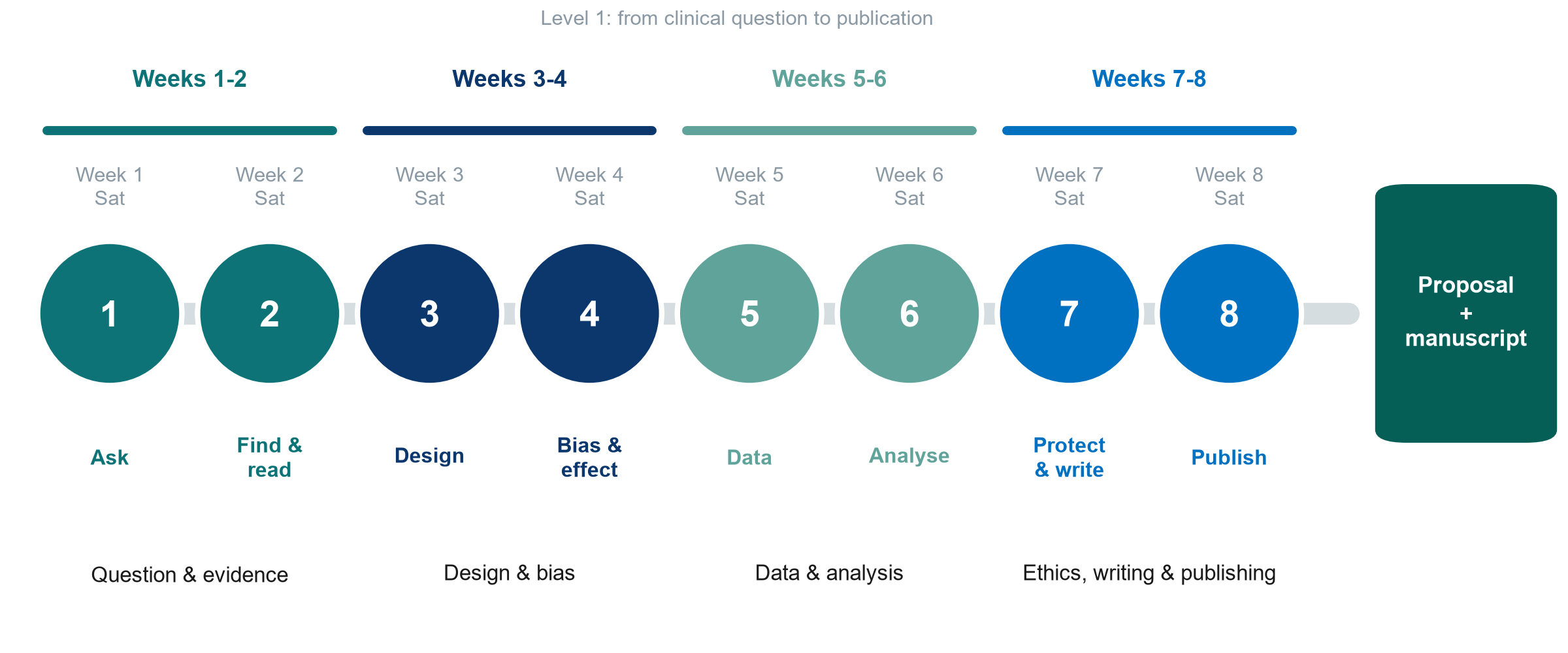
This course is Level 1 of three
Level 1 (this course)
- From question to publication
- Ask, design, analyse, write and publish
- 8 sessions, whole department
Level 2 (hands-on)
- Statistical modelling in R
- Linear, logistic, count, Cox
- Table 1, missing-data basics
- Your own analysis project
Level 3 (advanced)
- Research craft and advanced methods
- Reproducibility, Git, Quarto
- Journal figures, sensitivity analyses, meta-analysis
- More on request
KEY MESSAGE Level 1 is this course, Level 2 is statistical modelling in R, Level 3 is advanced methods.
Two things you will produce, each on your own
Both are individual work. We guide every step in class.
Your research proposal
- On a question from your own department
- Built one part at a time, Sessions 1 to 7
- Submitted by everyone in Session 8
- A few volunteers also present it
A draft manuscript
- Based on the course study, FLUID-ICU
- You choose one of its five questions (Q1 to Q5)
- We give you the results. You write the paper
- After Session 8 you review one colleague’s draft
By the end of the course you will be able to
Ask & find
- Turn a problem into a PICO question
- Search PubMed and manage references
- Read a paper in 15 minutes
Design
- Pick the right study design
- Recognise bias and confounding
- Read RR, OR, NNT and forest plots
Analyse
- Plan good data and a CRF
- Read CIs, p-values and regression
- Interpret a real dataset’s results
Write & publish
- Plan ethics and registration
- Write each section of a paper
- Submit and answer reviewers
KEY MESSAGE Understand and interpret: you will not be asked to calculate.
How each session runs
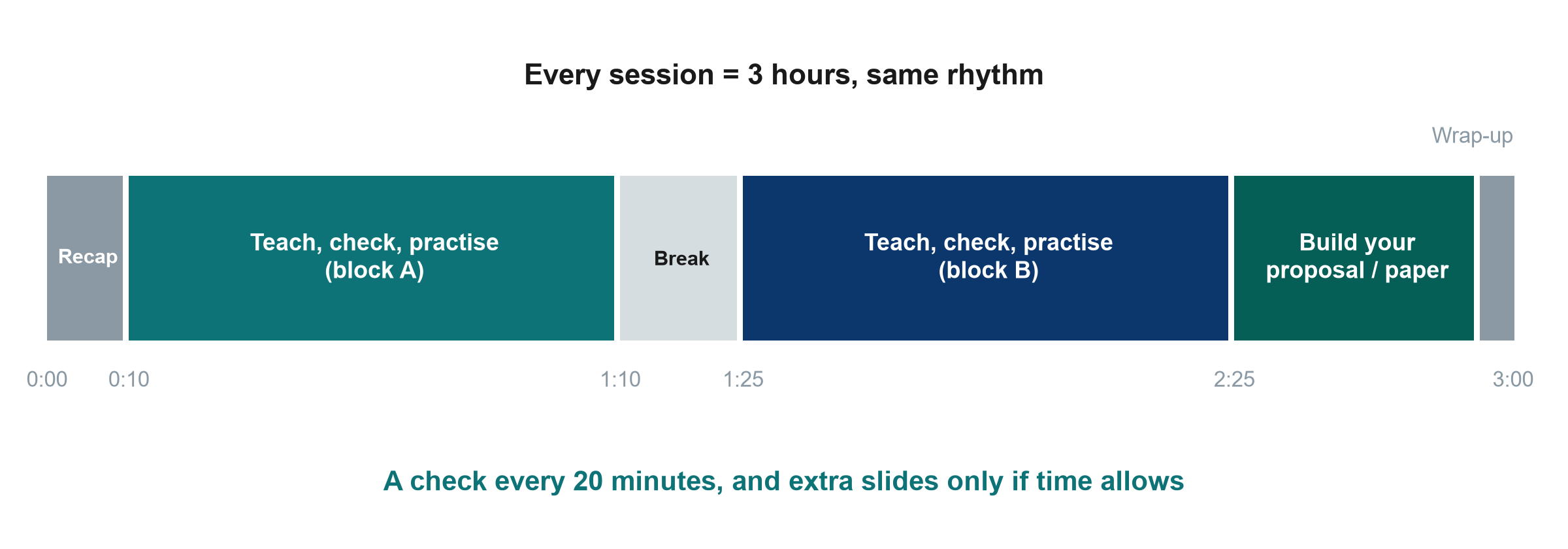
Build your proposal one part at a time
Part 1
- Sessions 1-2
- Question, background, aims
Part 2
- Sessions 3-4
- Design and participants
Part 3
- Sessions 5-6
- Data collection, sample size, analysis plan
Part 4
- Session 7
- Ethics, feasibility, publication plan
Submit
- Session 8
- Complete proposal submitted
KEY MESSAGE Your own question, one template, one part every two weeks, submitted in Session 8.
Welcome: introduce yourself
WHOLE-CLASS TASK · 6 min
- Type your name, department and profession in the chat
- Add one question you wish research could answer in your department
- Read the other messages: many are possible research topics
- A few of you then say your question with the microphone on. We keep the full list for your proposals
Example message
- Lan, ICU, nurse
- ‘Do patients with septic shock need less fluid than we give?’
OUTPUT One introduction per person in the chat, and a few spoken questions
How we learn together online
Ask anything
- There are no silly questions
- Use the chat or ‘raise hand’
Go slow
- We check understanding often
- Extra slides only if time allows
Bring your department
- Use examples from your own practice
- No patient names or details
Online habits
- Camera on when you can
- Microphone off unless speaking
- When called on, answer with the microphone on
- Back on time after the break
Pre-course quiz (online form)
QUICK QUIZ · 15 min
- Open the quiz form: the link is in the chat now
- 24 multiple-choice questions, one answer each (about 12 minutes)
- Work alone: no notes and no colleagues
- Guess if you are not sure: this is not an exam
- Enter your participant code, not your name
Why a quiz now?
- Shows where the class starts
- The same quiz again in Session 8
- We measure the course, not you
OUTPUT Form submitted (participant code only)
Session 1 · Ask: from clinical problem to research question
Part 1
Week 1 · Saturday
- 1.1 Why research? Evidence, the two course papers, types of research, the road to publication
- Break
- 1.2 From problem to question: PICO(T) and PECO, FINER, a whole-class task
- 1.3 Aims, objectives and hypotheses (quick exercise)
- Proposal builder 1: start your own question, aim and objectives
- Wrap-up: key words, recap, exit question, homework for next Saturday
1.1 Why research?
Why do we need research when we already have experience?
35 minutes: evidence, the two course papers, the pyramid, types of research and the road to publication
Anecdote vs evidence
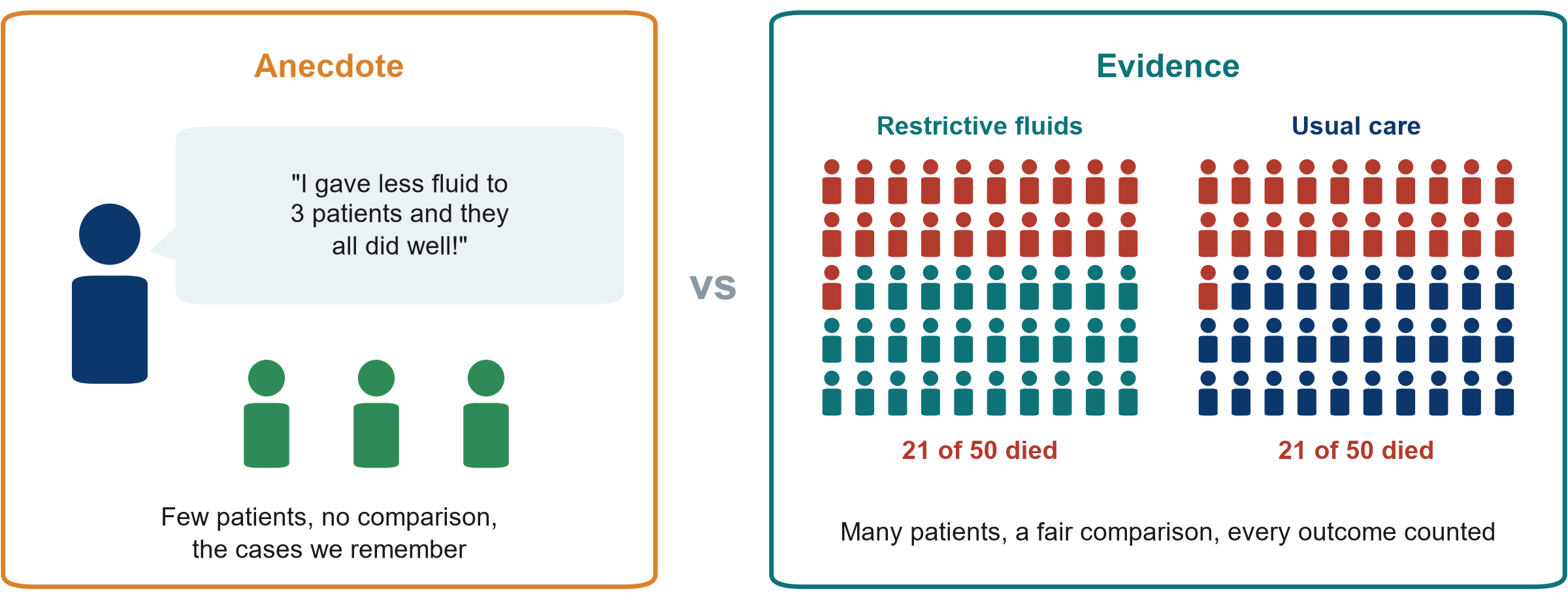
KEY MESSAGE Experience suggests questions. Fair comparisons in many patients answer them.
Why one ward’s experience is not enough
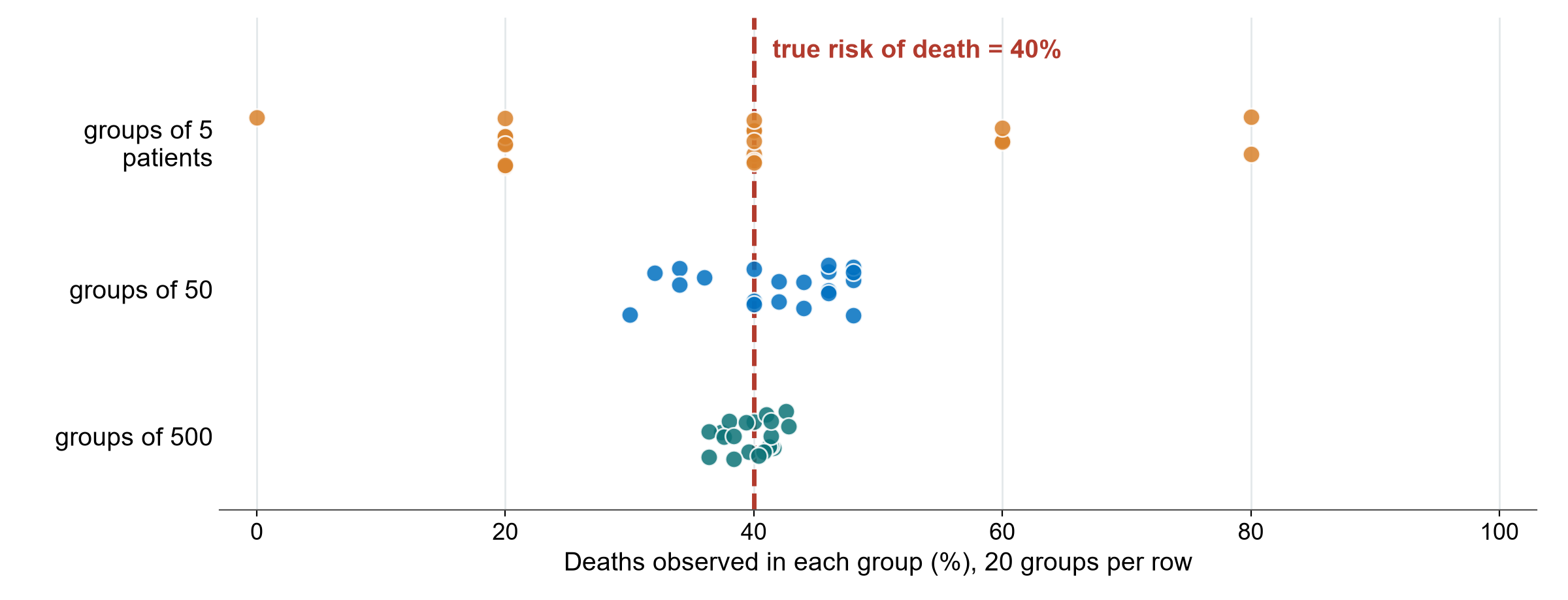
KEY MESSAGE Small numbers jump around by chance. Large, fair comparisons settle down.
The two papers we read together in this course
Both are in the course folder, Course/Papers: the original and an annotated copy in English and Vietnamese.
Paper 1: Boulet 2024, a trial
- Boulet N, et al. Crit Care 2024;28:429
- Impact on fluid balance of an optimized restrictive strategy targeting non-resuscitative fluids in intensive care patients with septic shock
- A small pilot randomised controlled trial (RCT) of 48 patients
- Main outcome: fluid balance at day 5
Paper 2: Hyun 2023, a cohort
- Hyun DG, et al. Ann Intensive Care 2023;13:105
- Impact of a cumulative positive fluid balance during the first three ICU days in patients with sepsis
- A matched cohort study from the Korean sepsis registry
- Main outcome: death by day 28
KEY MESSAGE Paper 1 is a trial, Paper 2 is a cohort. Both study fluids in sepsis.
The evidence pyramid
How to read it
- Higher = less risk of bias for questions about treatment effects
- Paper 1 (Boulet 2024) is a trial. Paper 2 (Hyun 2023) is a cohort
- A well-done cohort can beat a poorly done trial
- Descriptive questions do not need a trial
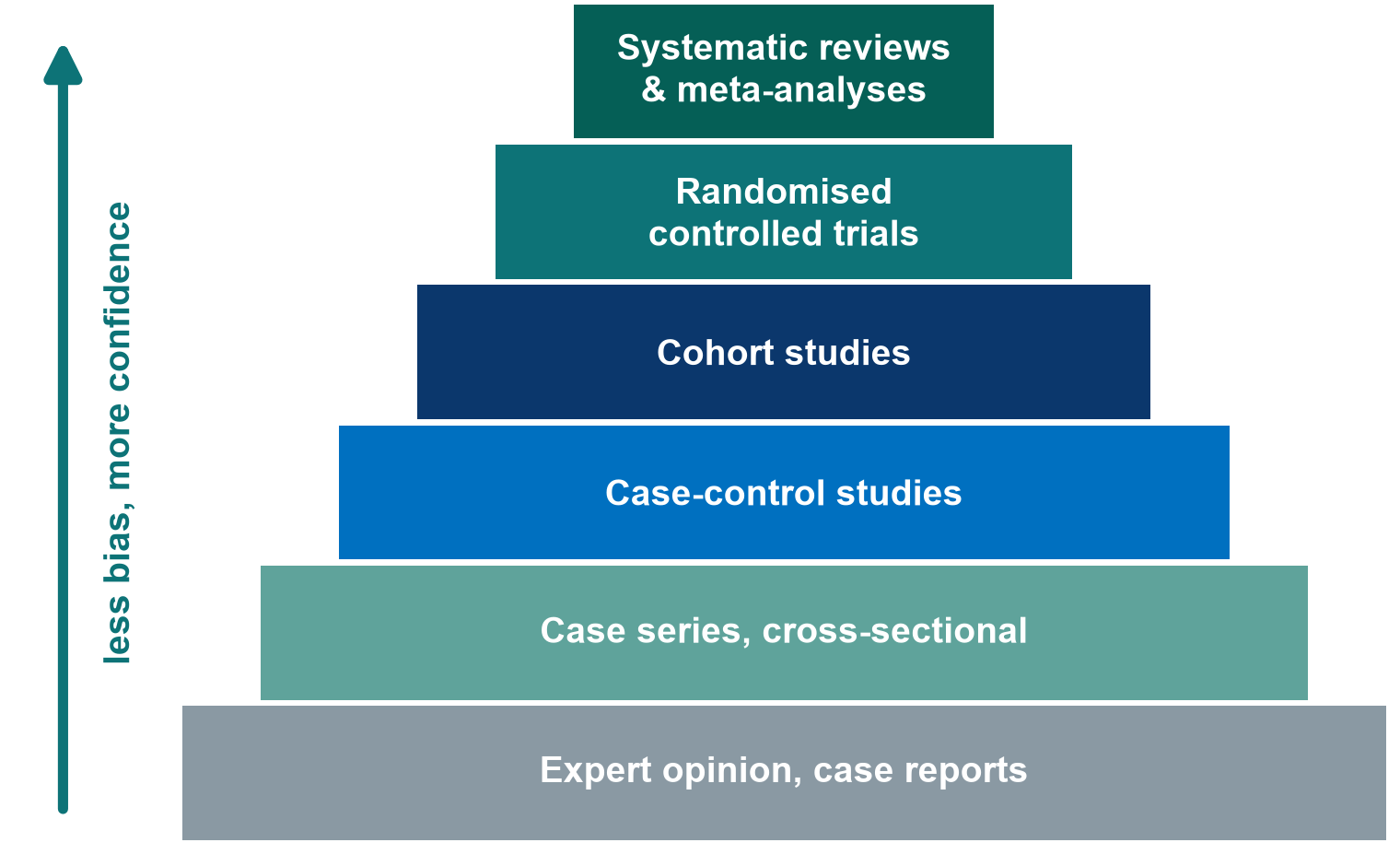
KEY MESSAGE The pyramid ranks designs, not individual papers: quality still has to be checked.
Quick quiz: rank the evidence
QUICK QUIZ · 3 min
- The question: do restrictive fluids reduce deaths in septic shock?
- A: a senior colleague says, ‘In 20 years, my patients kept dry did better’
- B: a study that followed thousands of ICU patients with sepsis in a registry (a cohort)
- C: a trial that randomly assigned 1,554 patients to restrictive or usual fluids
- D: a systematic review that combines all trials of fluid restriction
- Vote in the poll: which order runs from weakest to strongest?
Poll options
- A, B, C, D
- B, A, C, D
- A, C, B, D
- D, C, B, A
OUTPUT Poll results on screen, then one question: what could make C weaker than B?
The research cycle
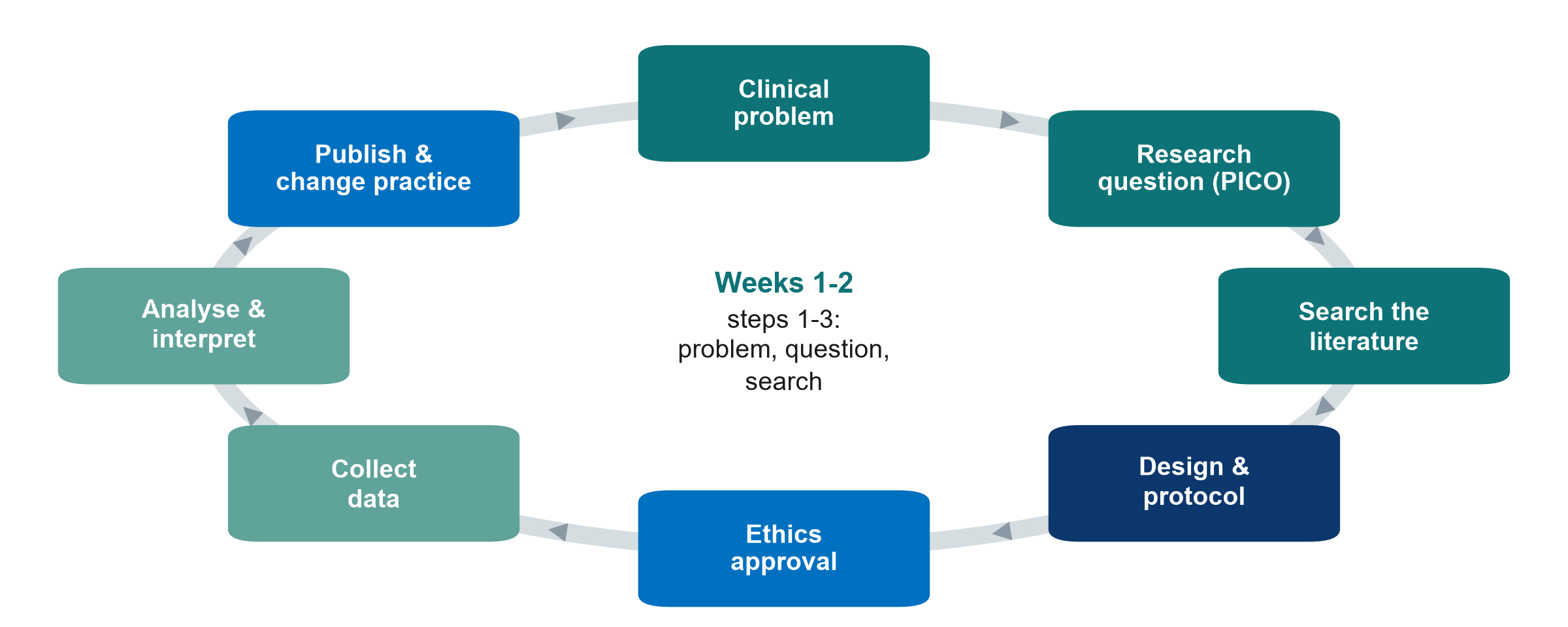
KEY MESSAGE Research is a cycle: published results change practice and raise new questions.
The question decides the type of research
| Type of research | What it gives | Example |
|---|---|---|
| Quantitative | Numbers: how many? Does X change Y? | 28-day mortality with two fluid strategies |
| Qualitative | Words: why? How? What is it like? | Interviews: why nurses hesitate to stop fluids |
| Mixed methods | Numbers + words in one study | Survey of fluid practice + focus groups |
| Primary research | You collect new data: trial, cohort, survey, interviews | Paper 1: a new trial |
| Secondary research | You reuse data that exist: records, registries, systematic reviews | Paper 2: a sepsis registry |
KEY MESSAGE Numbers answer how many and how much. Words answer why and how.
Check your understanding: which type of research?
QUICK QUIZ · 2 min
- A: counting how many patients with septic shock are fluid-positive on day 3 this year
- B: interviewing ICU nurses about why they hesitate to stop IV fluids
- C: re-analysing 3 years of ICU records for fluid balance and death
- D: a survey of fluid prescribing plus focus groups with doctors
- For each: numbers, words or both? New data or existing data?
OUTPUT Two or three people answer aloud, e.g. ‘A: numbers, new’. The next slide shows them
Answers: which type of research?
A Counting
- Quantitative
- Primary
- (new counts)
B Interviews
- Qualitative
- Primary
- (words, why)
C Old records
- Quantitative
- Secondary
- (data exist)
D Survey + groups
- Mixed methods
- Primary
- (numbers + words)
KEY MESSAGE Ask two things: numbers or words? New data or existing data?
The whole road: from idea to publication
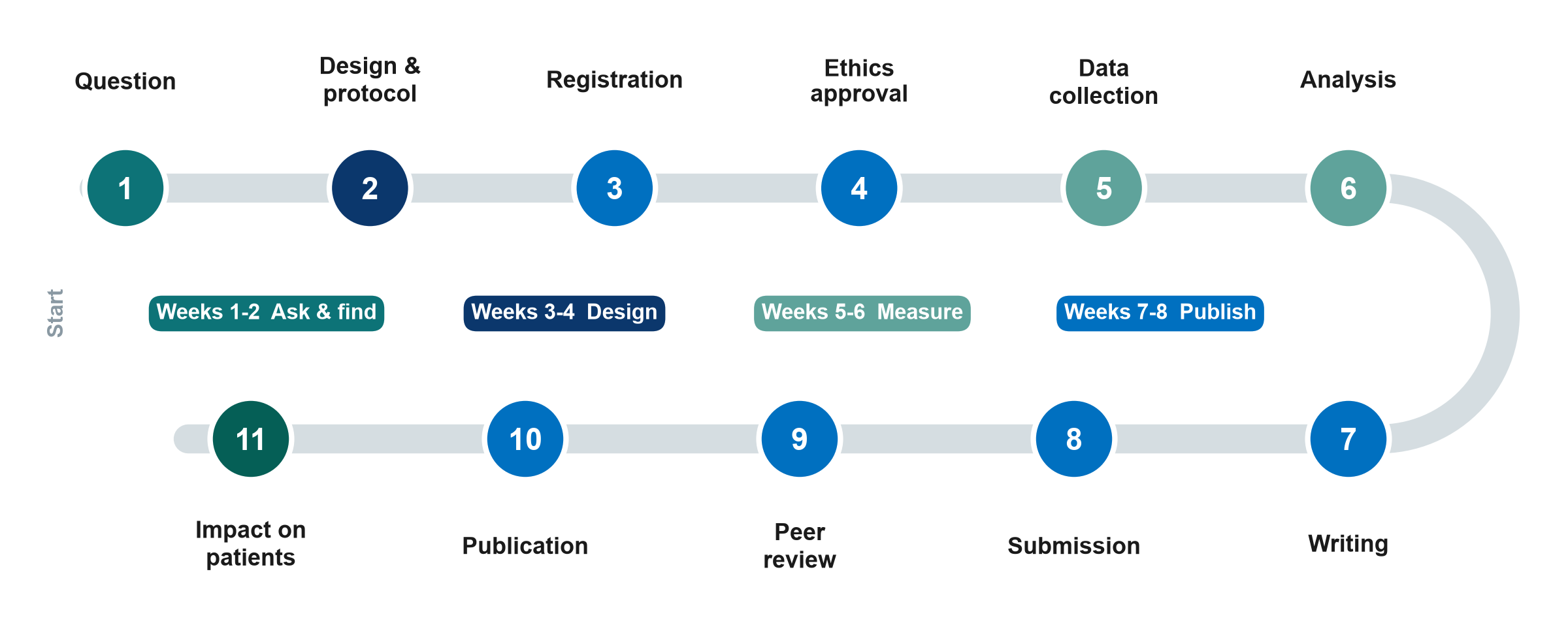
KEY MESSAGE This course walks the whole road. Your proposal covers stops 1 to 6.

Break
15 min
1.2 From problem to question
A good question is half of the answer.
40 minutes: where questions come from, PICO(T) and PECO, question types and FINER, then a whole-class task
Where do research questions come from?
Clinical uncertainty: is the answer already known? How we find out: search first.
Where questions come from
- Bedside doubt: “Why do we do it this way?”
- Variation: colleagues do it differently
- Audit, incident and registry data
- Guidelines that say “low-certainty evidence”
- Papers ending with “more research is needed”
- Questions from patients and families
Yes: known
- Apply it
- Guideline, audit or quality improvement (QI) project
No or unsure
- Research question
KEY MESSAGE If the answer is known, apply it. If it is not, you have a research question.
PICO(T): our running example
In adults with septic shock in the ICU, does a restrictive fluid strategy, compared with usual care, reduce 28-day mortality?
P Population
- Adults (18+) with septic shock in the ICU
I Intervention
- Restrictive fluid strategy
C Comparison
- Usual care (standard fluids)
O Outcome
- Death from any cause
T Time
- Within 28 days
KEY MESSAGE Every session we come back to this one question.
Three more examples: PICO, PECO and P + O
| P | I / E | C | O | T |
|---|---|---|---|---|
| Treatment (PICO) | Ventilated adults in the ICU | Twice-daily bed-head checklist | Usual care | Ventilator-associated pneumonia |
| Risk factor (PECO) E = Exposure | Adults on the medical ward | Obesity (BMI 30+) | BMI under 30 | New pressure injury |
| How common? (P + O) | Adults 65+ after hip surgery | - | - | Delirium (4AT screen) |
KEY MESSAGE PECO: E = Exposure, used when we cannot assign the factor (e.g. obesity).
Check your understanding: spot the PICO
QUICK QUIZ · 3 min
- Paper 1’s question (Boulet 2024): ‘In adults with septic shock in the first 24 hours of vasopressors, does restricting non-resuscitative fluids, compared with usual care, reduce cumulative fluid balance at day 5?’
- Which words are P, I, C, O and T?
- Poll: which words are the outcome (O)?
- Then two or three people say the population (P), microphone on
Poll options
- A: septic shock
- B: restricting non-resuscitative fluids
- C: cumulative fluid balance
- D: day 5
OUTPUT Poll answer, then P said aloud. The full answer is on the next slide
Answer: spot the PICO in Paper 1’s question
P
- Adults with septic shock
- First 24 hours of vasopressors
I
- Restricting non-resuscitative fluids
C
- Usual care
O
- Cumulative fluid balance
T
- Day 5
KEY MESSAGE The condition that brings patients in (septic shock) is part of P, not O.
Two families of questions
The question decides the design (more in Session 3).
Descriptive
- What? How many? Who?
- “How many of our septic shock patients have a positive fluid balance on day 3?”
- Case series, cross-sectional
Analytical: observe
- Is X linked to Y?
- Observe (no intervention)
- “Is a positive fluid balance associated with death?”
- Cohort, case-control
Analytical: intervene
- Does X cause Y?
- Intervene (we assign)
- “Does restricting fluids reduce 28-day mortality?”
- Randomised controlled trial
KEY MESSAGE Descriptive questions describe. Analytical questions compare or test a cause.
From a vague worry to an answerable question
Vague
- “Are fluids bad for ICU patients?”
- Which patients?
- Which fluid, how much?
- Bad compared with what?
- Bad how? By when?
Answerable, with PICO
- P: In adults with septic shock in the ICU,
- I: does a restrictive fluid strategy,
- C: compared with usual care,
- O: reduce mortality
- T: at 28 days?
KEY MESSAGE If you cannot fill all four PICO boxes, the question is not ready yet.
FINER: is the question worth asking?
Check every question against five tests before you invest time in it.
F Feasible
- Enough patients
- Time, money and skills
- Data you can get
I Interesting
- To you and your team
- To readers
N Novel
- Confirms, refutes or extends what is known
E Ethical
- An ethics committee could approve it
R Relevant
- Could change practice, policy or research
KEY MESSAGE If the question fails one letter, rewrite it before going further.
FINER check of our running example
Restrictive fluids vs usual care in septic shock: 28-day mortality, in our own ICU.
F Feasible
- Red
- Mortality needs more than 1,000 patients
- Too big for one unit
I Interesting
- Green
- Fluids are debated on every ward round
N Novel
- Amber
- Large trials exist: CLASSIC 2022 and CLOVERS 2023
E Ethical
- Amber
- Both strategies are used today
- Consent in the ICU needs care
R Relevant
- Green
- Every patient with septic shock gets fluid
KEY MESSAGE Important, but not feasible for one unit: rewrite it, e.g. as a pilot like Paper 1.
Whole-class task: rescue our running example
WHOLE-CLASS TASK · 11 min
- Open the Session 1 exercise sheet (PDF sent before the session), Exercise 1
- It gives three feasible versions of our question: A, B and C (right)
- Poll: which version could our own ICU do within two years?
- For the version most of the class chose, people called on give P, I or E, C, O and T aloud
- Together: name the question type and give each FINER letter a colour
- Together: write H0 and H1, or say why none is needed
The three versions
- A: restrictive protocol vs usual care. Fluid balance at day 5 (a pilot trial)
- B: fluid-positive vs not by day 3. Death by day 28 (a cohort)
- C: how many of our patients are fluid-positive on day 3? (descriptive)
OUTPUT One class question with PICO(T), FINER colours and H0/H1, typed on the shared screen
1.3 Aims, objectives, hypotheses
A question tells us what we want to know. Aims and objectives tell us what we will do.
20 minutes: aim, objectives, null and alternative hypotheses, and one quick exercise
Aim, objectives, hypothesis: our running example
Aim
- The broad why, in one sentence
- To compare a restrictive fluid strategy with usual care in adults with septic shock in the ICU
Objectives
- The specific what, with measurable verbs
- Primary: compare 28-day mortality
- Compare fluid balance at day 5
- Compare kidney injury needing dialysis
Hypothesis
- The predicted answer to the primary objective
- H0: 28-day mortality is the same in both groups
- H1: 28-day mortality differs between the groups
KEY MESSAGE One aim, 2-3 measurable objectives, one testable hypothesis per main objective.
Objectives start with a measurable verb
Vague verbs
- understand, know, study, explore, look at
- “To understand fluid management in our ICU”
Measurable verbs
- compare, estimate, describe, determine, measure
- “To compare cumulative fluid balance at day 5 between the two groups”
KEY MESSAGE If you cannot say how you will measure it, it is not yet an objective.
Null and alternative hypotheses
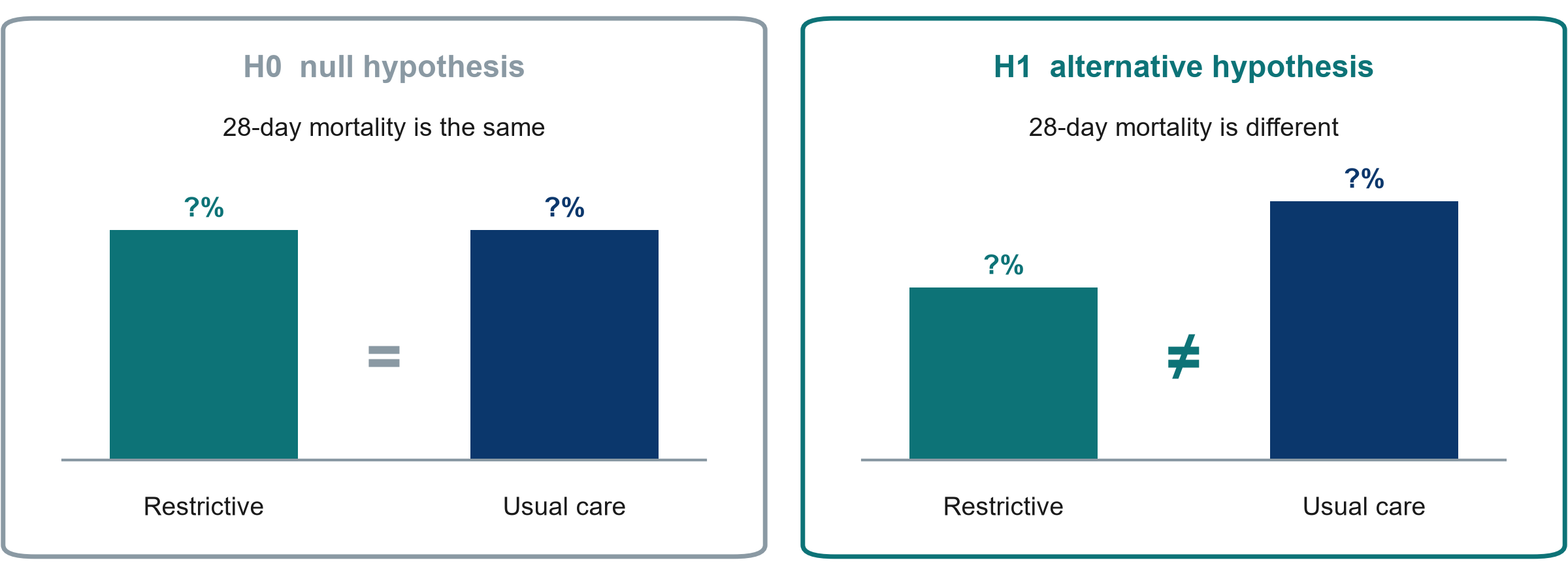
KEY MESSAGE We test H0. Data can reject it or fail to reject it, but never prove it.
Quick exercise: aim, objectives and hypothesis for the pilot
INDIVIDUAL TASK · 7 min
- Our pilot question (version A of Exercise 1): in adults with septic shock, does a restrictive fluid protocol, compared with usual care, reduce cumulative fluid balance at day 5?
- On your own, write one aim: ‘To compare…’
- Write two objectives with measurable verbs. Mark the primary one
- Write H0 and H1 for the primary objective
- Two or three people read their primary objective aloud
Verbs that work
- compare
- estimate
- describe
- determine
- measure
OUTPUT Exercise 2 on the Session 1 exercise sheet. Model answer on the next slide
Model answer: the pilot question
Aim
- To compare a restrictive fluid protocol with usual care in adults with septic shock in our ICU
Objectives
- Primary: to compare cumulative fluid balance at day 5 between groups
- Secondary: to estimate the recruitment rate and protocol adherence
Hypothesis
- H0: fluid balance at day 5 is the same in both groups
- H1: it differs between the groups
KEY MESSAGE Aim, primary objective and hypothesis all name the same outcome.
Proposal builder 1
Now start your own proposal: one question, one aim.
30 minutes: we model Part 1 on the running example, then you draft your own
Proposal builder 1: your own question
PROPOSAL BUILDER · 30 min
- Watch: we fill Part 1 of the proposal template for the running example
- Open your copy of the template (sent by email before the session)
- Choose one problem from your own department
- Write your PICO(T) question in one sentence and check it with FINER
- Add one aim, 2-3 objectives (mark the primary) and H0/H1
- Two volunteers read their question aloud. Others suggest one improvement, microphone on
Timing
- 0-8 min: we model Part 1
- 8-25 min: you draft your own
- 25-30 min: two volunteers share
OUTPUT Your Proposal Part 1 started: question, FINER check, aim, objectives, hypothesis
Key words of the day
| Key word | In one line |
|---|---|
| Evidence pyramid | Ranks designs by how well they protect against bias |
| PICO(T) | Population, Intervention, Comparison, Outcome, Time |
| PECO | The same, with E = Exposure, for factors we do not assign |
| FINER | Feasible, Interesting, Novel, Ethical, Relevant |
| Aim / objective | The broad why / the specific, measurable what |
| H0 / H1 | No difference / a difference (we test H0) |
Session 1 recap
Why research
- Experience suggests questions
- Fair comparisons in enough patients answer them
Ask precisely
- A PICO(T) question
- One primary outcome
- A FINER check before you start
Plan it
- One aim
- 2-3 measurable objectives
- A testable H0 and H1
KEY MESSAGE Next Saturday: find and read what is already known about your question.
Exit question (in the chat)
QUICK QUIZ · 2 min
- Answer now in the chat, or in the 1-question form linked there
- Q1: which FINER letter did our running example fail, and why?
- Q2: rewrite as an objective: ‘To understand fluid balance in our ICU’
Why we ask
- It is not homework and not marked
- It shows us what is still unclear
- We read every answer before next Saturday
- Session 2 opens with what we find
OUTPUT One short answer per person, before you leave
Homework for next Saturday (Session 2)
INDIVIDUAL TASK
- Finish your own Proposal Part 1 draft: question, FINER check, aim, objectives, H0/H1
- Exercise 4 on the Session 1 exercise sheet: 2-3 English synonyms for each PICO word
- Install Zotero (free, zotero.org) and its Word plug-in: required before Session 2
Ready for next Saturday
- Your PICO question
- Your synonym list
- A computer with internet and Zotero
OUTPUT Question, synonym list and Zotero ready for next Saturday’s search
Extra slides: Session 1
Use if time allows, or for self-study
Research, audit or quality improvement?
| Research | Clinical audit | Quality improvement |
|---|---|---|
| Asks | What is the best practice? | Are we meeting the standard? |
| Fluid example | Restrictive vs usual: which is better? | Is fluid balance recorded daily? |
| Results apply to | Patients elsewhere (generalisable) | Our unit |
| Ethics | Ethics committee approval: always | Local approval, usually no committee |
Not sure which it is? Ask the ethics committee before you start. Journals ask for approval or a waiver.
KEY MESSAGE Research asks what is best. Audit asks if we do it. QI makes it better.
PICO for other kinds of question
Diagnosis
- P: patients tested
- I: the new test
- C: the reference standard
- O: accuracy
- Example: in adults with suspected sepsis in the emergency department, how accurate is qSOFA compared with the full Sepsis-3 criteria?
Prognosis
- P: patients with a condition
- E: a risk factor (Exposure)
- O: what happens
- T: by when
- Example: in adults with septic shock, is a lactate above 4 mmol/L on admission linked to death by day 28?
Qualitative (SPIDER)
- S: Sample
- PI: Phenomenon of Interest
- D: Design
- E: Evaluation, R: Research type
- Example: how do ICU nurses (S) experience stopping IV fluids (PI), in interviews (D), in terms of barriers (E), in a qualitative study (R)?
KEY MESSAGE The letters change, but the idea stays the same: be explicit.
More practice: which FINER letter fails?
QUICK QUIZ · 4 min
- All hospitalised adults in the country: does vitamin D reduce mortality over 10 years?
- Septic shock: does withholding antibiotics for 24 h reduce resistance?
- Do our ICU nurses wash their hands? (already audited monthly for 5 years)
- Pneumonia: does the colour of the drug chart affect 28-day mortality?
OUTPUT One letter per question, in the poll
Vague vs answerable: another example from the ward
Vague
- “Are fluids bad for ICU patients?”
- Which patients?
- Which fluid, how much?
- Bad compared with what?
- Bad how? By when?
Answerable, with PICO
- P: In adults with septic shock in the ICU,
- I: does a restrictive fluid strategy,
- C: compared with usual care,
- O: reduce mortality
- T: at 28 days?
KEY MESSAGE Practise on your own ward: take a corridor question and fill the PICO boxes.
Copyright © Neudata, 2026
All property rights and copyright are reserved.
This presentation contains proprietary data, information, and materials developed by Neudata for dedicated use only and may not be communicated, copied, reproduced, distributed, published, or cited, in whole or in part, without the prior written consent of Neudata. Where explicit written permission has been granted, appropriate attribution must be included, followed by “by courtesy of Neudata”.
Any unauthorized use or infringement of these materials may give rise to legal action and claims for damages, without prejudice to any other rights of Neudata, including rights relating to patents, trademarks, or other forms of intellectual property protection.

Neudata | #ClearDataClearImpact